Buying Tips
True Fit vs Fit Analytics vs Kiwi Sizing vs Sizely (2026)
We compared True Fit, Fit Analytics, Kiwi Sizing, and Sizely on price, platforms, and published accuracy, using dated primary sources only.
Jason
August 10, 2026

We pulled the official size charts of six major brands. The same size 6 has a different bust, waist, and hip at each one. Here is the data, and how to cope.
Written by
Jason
Published on
July 11, 2026
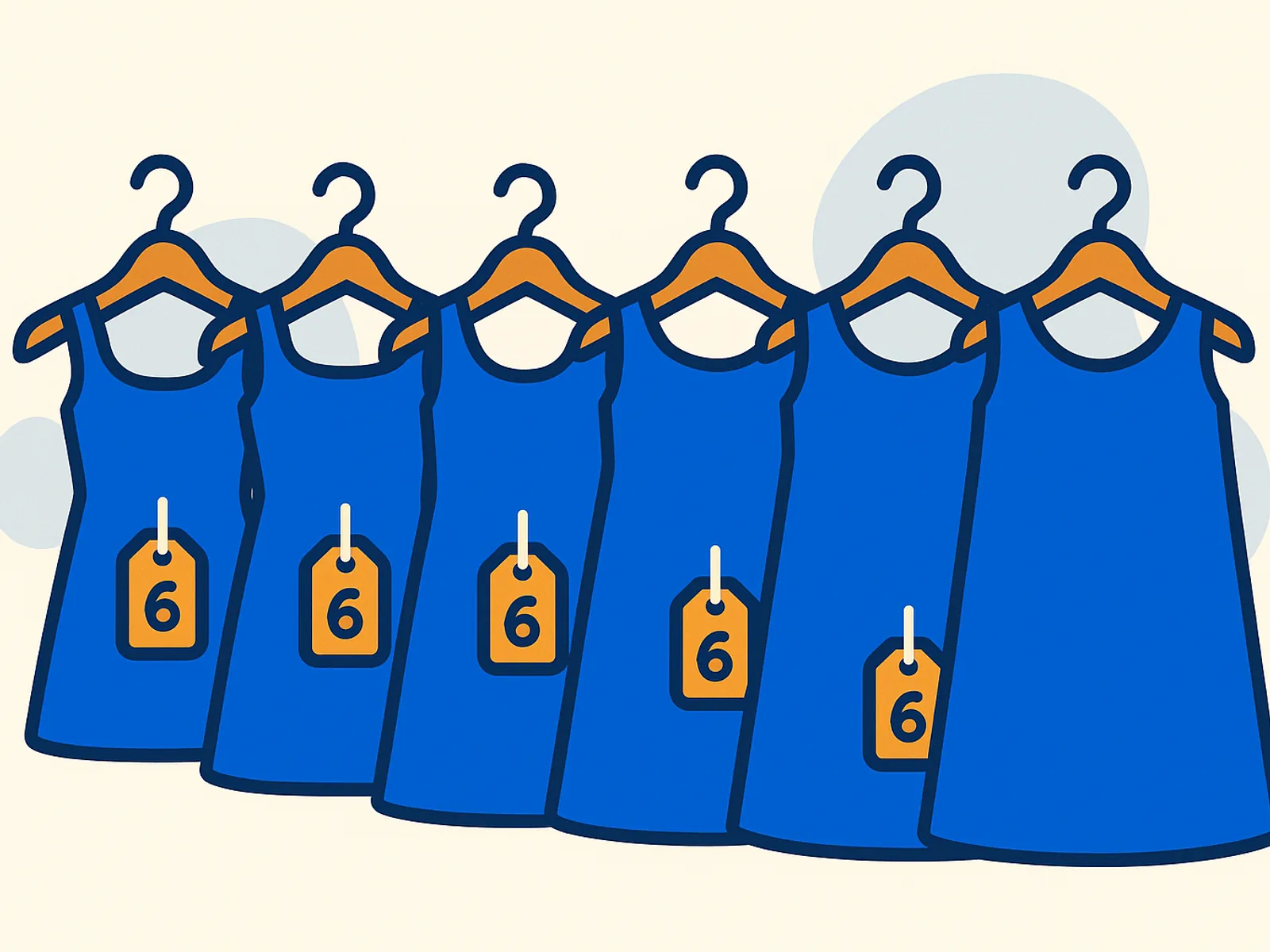
A size 6 means something different at every brand because nothing makes brands agree. The US withdrew its own sizing standard in 1983, ASTM's replacement is voluntary, and every label draws its own fit block. The measured result is below: across six official charts pulled on July 11, 2026, the size 6 bust alone spans a full inch. Sizes on those same charts step about an inch apart, so a one inch gap between two brands is a whole size and not a rounding quirk.
Short answer
You are a size 6. You have the receipts, a closet full of sixes that fit. Then you order a 6 from a brand you have not tried, and it will not close at the waist, or it hangs off the shoulders like a tent. Nothing about your body changed between one order and the next. The only thing that moved was whose chart drew the 6.
We wanted to see how far apart the charts really are, so we went to the source. Below is what six brands publish for their own size 6, each number traceable to the page it came from.
On July 11, 2026, we opened the official size guide for six brands and copied the body measurements each one lists for a women's size 6: bust, waist, and hip, in inches, exactly as printed. We picked brands that a lot of people actually wear, across mall staples, a cool-girl label, a heritage classic, and a department-store house brand: Gap, Old Navy, Madewell, Reformation, Talbots, and Nordstrom's Hinge.
A few ground rules. We used each brand's standard women's body chart, not a garment-specific one, so the comparison is fair, and we left the numbers as printed, fractions included. Old Navy lists a chest measurement rather than bust and keeps its hip figure on its pants chart, noted below. Every figure links to its source at the end. Nothing here is estimated.
| Brand | Bust | Waist | Hip |
|---|---|---|---|
| Gap | 35.25 in | 28.5 in | 38.25 in |
| Old Navy | 35.5 in (chest) | 28 in | 38.5 in |
| Madewell | 36 in | 28 in | 38 in |
| Reformation | 36 in | 28 in | 39 in |
| Talbots | 35 in | 28 in | 38 in |
| Hinge (Nordstrom) | 35 in | 27.5 in | 37.5 in |
Line the six up and the spread is real. The bust for a size 6 runs from 35 inches at Talbots and Hinge to 36 inches at Madewell and Reformation, a full inch. The waist runs from 27.5 inches at Hinge to 28.5 inches at Gap, again an inch. The hip is the widest gap, from 37.5 inches at Hinge to 39 inches at Reformation, an inch and a half. No two of these charts agree on all three measurements, and not one of them matches another brand exactly.
An inch does not sound like much. In sizing, it is everything.
Here is the part the spread hides. On almost every one of these charts, consecutive sizes are spaced about one inch apart. Gap's size 4 waist is 27.5 inches and its size 6 is 28.5 inches. Talbots goes 34, 35, 36 across sizes 4, 6, 8 in the bust. So a one inch difference between two brands is not a rounding quirk. It is a whole size.
Watch it happen to a real body. Take a woman with a 36 inch bust, which is a 91 cm bust. At Madewell and Reformation, that measurement is a size 6. At Talbots and Hinge, the exact same 36 inches is a size 8, because those brands cut their 6 an inch smaller. Same body, same tape, two different numbers on the tag. Widen the net to junior labels, which tend to run larger, or European brands, which tend to run smaller, and one body can swing further still.
Brands do not even agree with themselves. Reformation's numeric size 6 is a 28 inch waist, but its own lettered Medium is a 29 inch waist. The company sells you two names for the same rack and draws them an inch apart. Once you have seen that, the letter and the number both stop meaning much, and the only label left standing is the measurement.
None of this is an accident, and it is not new. The United States did once try to standardize women's sizes. In 1958 the National Bureau of Standards published a voluntary sizing system, Commercial Standard CS 215-58, built around bust measurement. It was never popular with manufacturers. The government made it fully voluntary in 1970 and withdrew it entirely in 1983, according to Wikipedia's entry on U.S. standard clothing size. A private group, ASTM International, published its own voluntary standard in 1995, and it has been revised since. The word doing the heavy lifting in all of that is voluntary. No brand has to follow any of it, and most do not.
Into that vacuum stepped vanity sizing, the slow habit of stamping a smaller number on the same garment so the shopper feels good at the register. The drift is measurable. Wikipedia's entry on vanity sizing cites the Sears catalog to show it: a dress with a 32 inch bust was a size 14 in 1937, the same 32 inch bust was a size 8 by 1967, and by 2011 it was a size 0. The body did not shrink. The label did. Your grandmother's 12 and your 6 can be the same dress.
Shoppers already know the tag lies, and they have a workaround: they buy the same item in two or three sizes, keep the one that fits, and send the rest back. The industry calls it bracketing, and it is common. Narvar's 2021 State of Returns report found that 58 percent of shoppers do it. It is a rational response to charts that will not agree, and it is expensive for everyone, since most of those extra sizes were always going back.
The cheaper move is to stop trusting the number and start trusting the tape. Measure your bust, waist, and hip once, write the three down in inches and centimeters, and read each brand's chart against your body instead of your usual size. When a product page gives real measurements, you skip the guessing and the second box. If you land between two sizes, size to the measurement that has to fit, usually the shoulders on a top or the hip on a dress, and tailor the rest.
If you sell clothing, this is the return you can prevent before it ships. The buyer is not confused about their body. They are confused about your 6. Give them the measurements and the confusion goes away. You can build a measurement-based Size Chart for your listings in about a minute with the free Sizely Size Chart maker, and paste it in with no code. If you run your own store, Sizely Fit Finder reads a shopper's measurements against your real chart and returns one size on the product page, sized to your garments rather than an industry average, which is why it lands the exact size 98.1 percent of the time and within one size 99.8 percent of the time, measured rather than estimated. Either way the shopper stops betting on a label and starts reading a number.
No. In the six official charts we pulled on July 11, 2026, a women's size 6 ranged from a 35 to 36 inch bust, a 27.5 to 28.5 inch waist, and a 37.5 to 39 inch hip. Since sizes step about an inch apart, a body that is a 6 at one brand is often a 4 or an 8 at another.
Vanity sizing is the practice of putting a smaller size number on a garment than an older standard would have. It flatters the shopper and sells more. Over decades it has pushed sizes down: Wikipedia notes a 32 inch bust was a size 14 in a 1937 Sears catalog, a size 8 by 1967, and a size 0 by 2011.
There is no enforced standard. The old government guideline, CS 215-58, was made voluntary in 1970 and withdrawn in 1983, and the ASTM standard that followed in 1995 is also voluntary. In practice, across the brands we checked, a size 6 clusters near a 28 inch waist, but the bust and hip vary by an inch or more from brand to brand.
Measure your bust, waist, and hip with a soft tape, keeping it level, and record all three in inches and centimeters. Then read each brand's own size chart against those numbers instead of ordering your usual size. If a store shows real garment measurements or a measurement-based size recommender, use it, since your body is the one thing that stays the same across every label.
Sellers who want to close that gap for shoppers have a few tools to choose from. Here is a side by side of the apps that recommend a size for the shopper.
Written by
More from the blog
Guides on how to measure yourself, read a brand's size chart, and convert sizes between brands and countries, so you order the right size the first time.
We compared True Fit, Fit Analytics, Kiwi Sizing, and Sizely on price, platforms, and published accuracy, using dated primary sources only.
Jason
August 10, 2026
Theme section, a size chart app, or a free chart image from Sizely. Three ways to add a size chart to Shopify, and what each one takes and costs.
Jason
July 11, 2026
Every big ecommerce returns stat in one place, traced to its primary source: 2025 return rates, why clothing comes back, and what cuts returns.
Jason
July 11, 2026