Buying Tips
True Fit vs Fit Analytics vs Kiwi Sizing vs Sizely (2026)
We compared True Fit, Fit Analytics, Kiwi Sizing, and Sizely on price, platforms, and published accuracy, using dated primary sources only.
Jason
August 10, 2026

Every big ecommerce returns stat in one place, traced to its primary source: 2025 return rates, why clothing comes back, and what cuts returns.
Written by
Jason
Published on
July 11, 2026
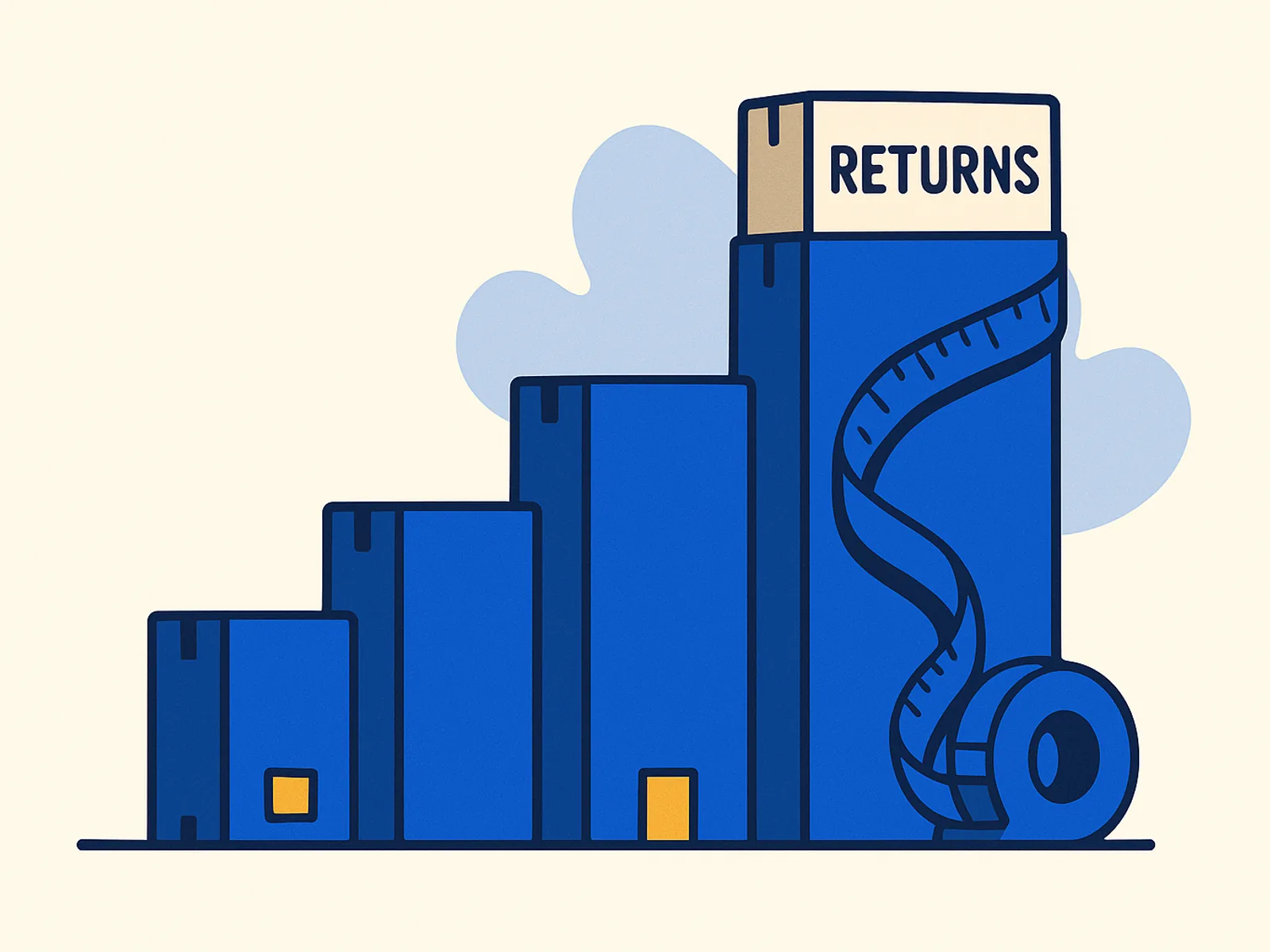
The average US online return rate is 19.3%, against 15.8% across all retail, according to the National Retail Federation and Happy Returns (2025). Online apparel runs far higher at 24.4%, and size and fit is the leading cause, named by 53% of apparel sellers (Coresight Research, 2023). So there is no single ecommerce return rate: the figure you want depends on the channel and the category you mean, which is why every number here carries its publisher and year.
The key numbers
Retailers expect shoppers to send back $849.9 billion in merchandise in 2025. That figure comes from the National Retail Federation and its returns partner Happy Returns, whose 2025 Retail Returns Landscape put the overall return rate at 15.8 percent of everything sold. Buy online and the rate climbs to 19.3 percent.
Those are the top-line numbers everyone quotes. What follows is the rest of the returns story, sourced. Each stat below is tied to the group that first published it, with the year, so you can check the primary source instead of the fifth blog that reworded it.
Total US retail returns are projected to reach $849.9 billion in 2025, according to the NRF and Happy Returns. That works out to 15.8 percent of sales, a hair below the 16.9 percent the same partnership reported for 2024, when returns totaled $890 billion. So the rate isn't spiking. It has settled at a high plateau that retailers now budget around rather than treat as a surprise.
Online is where the pain concentrates. The NRF and Happy Returns pegged the 2025 online return rate at 19.3 percent, well above the combined store-and-web figure. There's a plain reason a physical store returns less. You already tried the thing on before you paid for it.
Clothing comes back more than almost anything else you can buy online. Coresight Research, in a 2023 study of US apparel brands and retailers, put the online apparel return rate at 24.4 percent, which worked out to roughly $38 billion of clothing shipped back that year.
Coresight also asked sellers why the clothes came back. Size and fit was the top answer, named by 53 percent of respondents, far ahead of color at 16 percent and damage at 10 percent. Read that next to the return rate and the shape of the problem is hard to miss. The biggest category for returns has one dominant cause, and it's fit.
McKinsey ran the question a different way and landed in the same place. In its 2021 returns-management survey of North American apparel retailers, the firm found that about 70 percent of apparel returns trace back to poor fit or style. The wording matters. It's fit or style, not fit alone, and the honest version of the stat keeps both halves. A jacket that fits fine but looks wrong in daylight counts inside that 70 percent too.
In practice the two rarely separate. A shopper who can't tell how a garment will sit on their body is guessing on fit and look at the same time, and the guess is what drives the parcel back to the warehouse.
Some of those returns are decided before the box even ships. Narvar, in its 2021 State of Returns report, found that 58 percent of shoppers "bracket," the industry word for ordering the same item in two or three sizes with a plan to keep one and return the rest.
Bracketing is rational for the shopper and expensive for the seller. When a product page can't answer "will this fit me," ordering three sizes is the obvious workaround, and every extra size in that cart is a near-certain return already on its way home.
Here the honest answer gets narrower. Plenty of vendors sell fit-recommendation widgets and advertise large drops in returns, but those numbers are self-reported, measured on the vendor's own customers, and rarely published with the methodology attached. Treat them as marketing until the math is shown.
The one return-reduction figure that comes from peer-reviewed research rather than a sales page belongs to Zalando. In a paper presented at ACM SIGKDD (KDD) in 2021, Nestler and colleagues reported that their SizeFlags size-advice model cut size-related returns by 3.8 percent in a controlled A/B test with 720,000 customers in each group. Later production versions of the model landed in the mid-single digits, roughly 4 to 8 percent depending on the variant. Those are modest numbers next to vendor billboards, and that is exactly why they are worth trusting. They survived an A/B test and peer review.
Put the numbers together and the throughline is fit. Clothing returns more than other categories, size and fit lead the reasons, and bracketing multiplies the effect. The tactics that address the cause get a full treatment in our guide to reducing clothing returns, and the simplest of them is giving shoppers a straight answer to "what size am I" before they buy, which is what a size recommender on the product page is for.
Retailers expect an overall return rate of 15.8 percent in 2025, worth $849.9 billion, according to the NRF and Happy Returns. Online, the rate is higher, at 19.3 percent.
US online apparel returns at about 24.4 percent, per Coresight Research (2023). That was roughly $38 billion of clothing sent back in 2023.
Size and fit. Coresight Research (2023) found 53 percent of apparel sellers named it the top reason, and McKinsey (2021) attributed about 70 percent of apparel returns to poor fit or style.
Bracketing is buying the same item in several sizes or colors with the intention of keeping one and returning the rest. Narvar (2021) found 58 percent of shoppers do it.
The clearest neutral evidence is Zalando's SizeFlags study (KDD 2021), where size advice cut size-related returns by 3.8 percent in a 720,000-per-group A/B test. Vendor claims run higher, but they are self-reported, so the peer-reviewed figure is the safer one to plan around.
Ready to act on the numbers? Start with our guide to ecommerce returns solutions that actually cut return rates.
Written by
More from the blog
Guides on how to measure yourself, read a brand's size chart, and convert sizes between brands and countries, so you order the right size the first time.
We compared True Fit, Fit Analytics, Kiwi Sizing, and Sizely on price, platforms, and published accuracy, using dated primary sources only.
Jason
August 10, 2026
Theme section, a size chart app, or a free chart image from Sizely. Three ways to add a size chart to Shopify, and what each one takes and costs.
Jason
July 11, 2026
Returns solutions come in two types: tools that manage returns after they happen, and tools that prevent them. How they differ and which to buy first.
Jason
July 11, 2026