Buying Tips
True Fit vs Fit Analytics vs Kiwi Sizing vs Sizely (2026)
We compared True Fit, Fit Analytics, Kiwi Sizing, and Sizely on price, platforms, and published accuracy, using dated primary sources only.
Jason
August 10, 2026

Grading turns one fit-approved base size into a full range. How grade rules, common steps, and tolerances work, plus a worked example from a base medium.
Written by
Jason
Published on
July 11, 2026
Quick answer
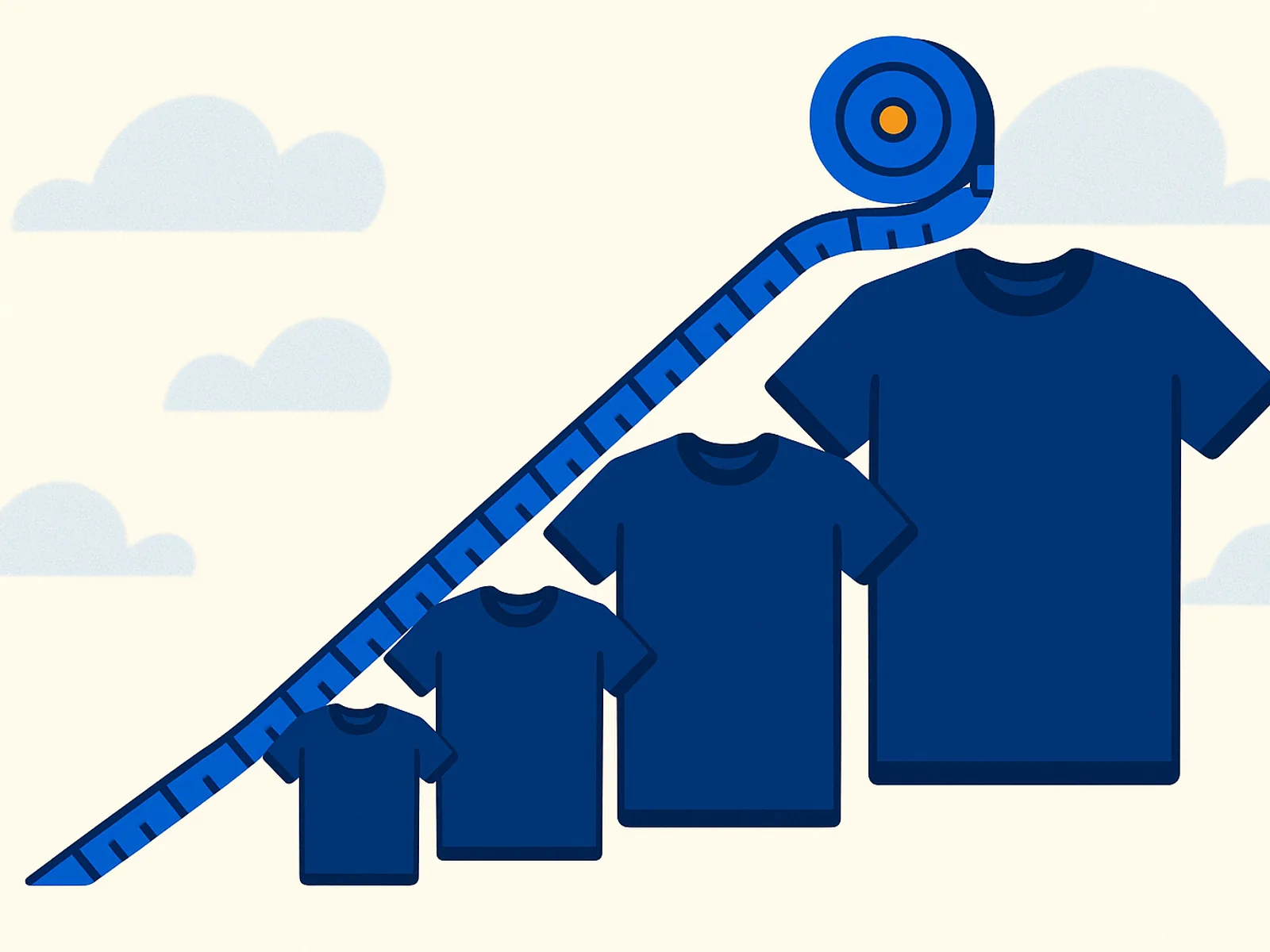
Size grading turns one fit-approved base pattern into a full run of sizes, scaling every measurement up and down in set steps so the fit stays consistent from your smallest size to your largest. The common approach:
You fit your sample on one body, then you have to make it in the other sizes you never fitted on anyone. Grading closes that gap: it scales your one approved base pattern up and down in measured steps, so a large fits a large customer the way your medium fits your fit model. Skip the method and the XS and XL are where returns collect.
Grading starts with a base size, sometimes called the sample size. That's the size you draft and fit first, the one your pattern is genuinely dialed in on. Many brands pick a medium for tops, or a size 8 for bottoms, since grading outward from the center keeps distortion at either end small. From that base you build every other size with grade rules, a grade rule being the amount a given point on the pattern moves as you step up or down one size.
One thing to be clear on: grading resizes a pattern, it doesn't re-fit it. It assumes the base fits, which holds near the base and gets shakier the further out you go, so the far ends of a range almost always need a real fit check rather than trust in the math.
Most small brands grade in the same order, by hand or with software. Lock the base first: don't grade until the base size is fit-approved, or you copy an unresolved fit into every size.
Next, set your size range and mark which sizes are core and which are extended. The core sizes are the middle of the run, usually S, M, and L, where bodies sit close to average and a steady grade works. The extended sizes are the edges, an XS or an XL and beyond.
Then set the grade for each point of measure, reading the numbers as common practice rather than a rulebook. No single sizing standard is required of US brands. Voluntary industry standards exist, for example ASTM publishes voluntary body-measurement standards that some brands reference, but most set their own grade rules around their own fit and customer. A common starting point is to grow the chest about 1 inch (2.5 cm) per size through the core and a bit more across the extended sizes, since bodies don't scale in a straight line at the edges.
Finally, apply the grade and re-fit the edges. Fit at least the smallest and largest size on a real body or form, because a small grade-rule error is invisible at the base and obvious three sizes out.
Here's a worked example on a knit top with a fit-approved medium. These are example garment measurements, not a standard, so take the shape as the lesson and use your own numbers.
| Size | Chest | Waist | Body Length |
|---|---|---|---|
| XS | 37 in / 94 cm | 33 in / 84 cm | 25 in / 63.5 cm |
| S | 39 in / 99 cm | 35 in / 89 cm | 25.5 in / 65 cm |
| M (base) | 40 in / 102 cm | 36 in / 91 cm | 26 in / 66 cm |
| L | 41 in / 104 cm | 37 in / 94 cm | 26.5 in / 67 cm |
| XL | 43 in / 109 cm | 39 in / 99 cm | 27 in / 68.5 cm |
The chest moves about 1 inch (2.5 cm) between core sizes and about 2 inches (5 cm) out to the extended ones, the waist follows a similar step, and the length grows a steady half inch (1.3 cm) per size. Lengths grade less than girth on purpose, since a taller size isn't proportionally as much longer as it is wider.
A point of measure, or POM, is a specific place you measure the garment: chest across the fullest part, waist, body length from the high shoulder point, sleeve, neck opening. Your spec lists every POM with a value for each size, and grading fills in that grid. A grade rule chart, sometimes just called a grading chart, lists the increment for every POM, like chest plus 1 inch per size or sleeve plus a quarter inch, so anyone can rebuild the range.
Different points get different increments on purpose. A neckline grows far less than a chest, and a cuff barely moves, so a good grade never applies one flat number to the whole pattern. The values also split across the pattern pieces: a 1 inch chest grade on a flat garment is shared between front, back, and side seams. Software handles the split once you enter the rule, and by hand you walk each grade point out by its share.
A tolerance is how far a finished garment can differ from the spec and still pass. No factory sews to the exact millimeter every time, so you give each measurement a small acceptable window, written as a plus or minus. As common practice, brands often allow around a half inch (1.3 cm) either way on big girth measurements like chest, waist, and hip, and a tighter quarter inch (0.6 cm) on smaller details like a neck opening or a cuff. These are typical ranges, not rules, set to the fabric and how fussy the fit is.
Your grade step and your tolerance shouldn't collide, either. If your chest grade is 1 inch per size and your tolerance is plus or minus a half inch, two neighboring sizes can overlap by nearly a full inch at the edges of their windows. That's fine on a soft knit and a problem on a fitted woven, so check the two against each other before you produce.
There are three common ways small brands get their sizes graded.
Manual grading is grading by hand. A patternmaker walks each grade point out by its increment with a ruler and a grading machine, tracing each new size off the base. It needs no software and gives full control, but it's slow and easy to slip on a long range or a complex pattern.
CAD grading software is the digital version. You digitize the base pattern once, enter your grade rules as a table, and it generates the whole nest of sizes at once. Editing one rule regrades the whole range, and the pattern grading software category runs from full apparel CAD suites down to lighter standalone tools. The tradeoff is the license cost and the learning curve, so it pays off most when you grade often.
Hiring a freelance grader is the middle path, and where many new brands land. You send a fit-approved base pattern and your size range, and the grader returns the graded set, often as files plus a spec. Many factories also offer grading in-house as part of sampling.
Once your range is graded, that spec is the source of truth for everything downstream, including the size chart your shoppers see. The chart on your product page should come from the same graded measurements you gave the factory, not typed in separately from memory, because the moment the two drift apart your customers read numbers your garments don't match.
The cleanest way to keep them in sync is to build the shopper-facing chart straight from your graded spec. You can turn those measurements into a clean, on-brand chart in about a minute with the free Sizely Size Chart maker, then keep it pointed at the numbers your factory works to. And since the whole grade lives inside your measurement spec, it's worth getting that document right first, so our guide to what a tech pack is covers the measurement sheet those graded values belong in.
A few grading mistakes show up again and again on a first production run.
Grading before the base fits. Every size inherits the base, so an unresolved fit there becomes an unresolved fit in all of them.
Applying one flat increment to the whole pattern. Necklines, cuffs, and armholes grade far less than chests and waists, so one number balloons the small details at the top of the range and pinches them at the bottom.
Treating extended sizes as a straight-line extension. Bodies don't scale linearly at the edges, so the core grade rarely carries cleanly to a 2XL or 3XL. Those sizes usually need their own grade and fit session.
Skipping the tolerance. With no allowed window on the spec, you either get units rejected over tiny, normal variation or no agreed standard when a measurement comes back off.
Letting the size chart drift from the spec. A published chart that no longer matches the graded garment sends every between-sizes shopper the wrong way and quietly feeds returns.
Size grading is scaling a fit-approved base pattern up and down to create a full range of sizes. You fit one base size, usually a medium, then apply set increments to each point of measure to build the sizes around it, so every other size is a measured copy of the base.
A grade rule is the fixed amount a single point on the pattern moves when you step up or down one size. A chest grade rule of 1 inch (2.5 cm) per size means the chest grows an inch each size up and shrinks an inch each size down. Every point of measure gets its own rule, and together they make up your grade rule chart.
It depends on how you do it, and pricing varies a lot by provider and pattern, so treat any number you see as a quote rather than a rate. Freelance graders and factories usually price per pattern or per size range, and some charge by the hour, while grading software is a subscription or a license. For a first style, a freelance grader or your factory's in-house grading is the lower-commitment option.
Yes. Plenty of small brands grade their own patterns, by hand with a ruler or with software once the volume justifies it. What matters most isn't the tool, it's knowing which points of measure grow by how much and remembering to re-fit the ends of your range. For a complex pattern or a wide range, a freelance grader can save you a costly production mistake.
Once your graded range is live, the next question is usually which sizing tool to put in front of shoppers. We compare what the size recommendation apps cost and what they cover.
Written by
More from the blog
Guides on how to measure yourself, read a brand's size chart, and convert sizes between brands and countries, so you order the right size the first time.
We compared True Fit, Fit Analytics, Kiwi Sizing, and Sizely on price, platforms, and published accuracy, using dated primary sources only.
Jason
August 10, 2026
Theme section, a size chart app, or a free chart image from Sizely. Three ways to add a size chart to Shopify, and what each one takes and costs.
Jason
July 11, 2026
Every big ecommerce returns stat in one place, traced to its primary source: 2025 return rates, why clothing comes back, and what cuts returns.
Jason
July 11, 2026