

Shoe Width Chart - Men & Women
Shoe width letters explained: B is medium for women but narrow for men, D is medium for men but wide for women. Charts in inches and cm, plus how to measure.
Last updated June 2026
Shoe width letters at a glance#
Shoe width is the girth of your foot across the ball, marked by a letter from A (narrowest) to E, EE and 4E (widest). The same letter fits differently by gender: B is medium for women but narrow for men, and D is medium for men but wide for women.
| Width Letter | Women&Rsquo;S Fit (foot width at US 8) | Men&Rsquo;S Fit (foot width at US 9) |
|---|---|---|
| A | Narrow, 3.2" / 8.1 cm | Narrower than C |
| B | Medium (standard), 3.55" / 9.0 cm | Narrow |
| C | Narrow to wide | Narrow, 3.6" / 9.1 cm |
| D | Wide, 3.95" / 10.0 cm | Medium (standard), 3.9" / 9.9 cm |
| E | Extra wide, 4.3" / 10.9 cm | Wide, 4.1" / 10.4 cm |
| EE (2E) / 4E | Extra wide and up | Extra wide (EE), ultra wide (4E) |
For women, B is the standard width and a US 8 B foot measures 3.55" / 9.0 cm, while a D is wide at 3.95" / 10.0 cm, about 0.4" / 1 cm broader. For men, D is the standard width and a US 9 D foot measures 3.9" / 9.9 cm, with B two steps narrower; an E runs 4.1" / 10.4 cm. A width letter only means something next to a length, so match the letter to your size row in the charts below.
These width letters and measurements are read directly from this page’s own women’s (US 5–12) and men’s (US 5–12) width charts in inches and centimeters, cross-checked against the standard North American width scale. Widths still vary by brand, so measure your foot where you can. See the international shoe size conversion chart to convert your size first, or the shoe size recommender to match width across brands.
Put exact measurements on every listing, whether you sell on eBay, Shopify, or your own store.
Create your free size chart
What shoe width letters mean#
Shoe widths are indicated by individual letters or combinations of letters, which can vary between men's and women's footwear. Ensuring you are buying shoes with the right width will increase your comfort levels when walking or doing sports. Below is a general breakdown of what the shoe width letters mean. For a more exact answer, find your size row in the charts further down.
Here's a general breakdown:
- A: Narrow width for women.
- B: Standard (medium) width for women; narrow width for men.
- C: Narrow width for men.
- D: Standard (medium) width for men; wide width for women.
- E: Wide width for men; extra wide for women.
- EE: Extra wide width for men.
- EEEE (4E): Ultra-wide width for men.
Note: Not all manufacturers use these exact letters, and the actual width can vary between brands.
Some brands skip the letters and mark widths N (narrow), M (medium) and W (wide) instead. M is the same fit as B in women’s shoes and D in men’s; W corresponds to D in women’s shoes and E to EE in men’s. So a women’s shoe marked 9W is roughly a 9D, and a men’s 10M is a 10D.
Women's shoe width chart#
The women’s chart below covers U.S. sizes 5–12 with European sizes, foot length in centimeters, and the foot width in inches and centimeters for each width letter. If you are uncertain about your foot width, follow the step-by-step measuring guide further down.
| Size (US) | Size (EU) | Length (cm) | a (Narrow) | B (Medium) | C/D (Wide) | E (Extra Wide) |
|---|---|---|---|---|---|---|
| 5 | 35–36 | 21.6 | 2.8" / 7.1 cm | 3.2" / 8.1 cm | 3.55" / 9.0 cm | 3.95" / 10.0 cm |
| 6 | 36–37 | 22.3 | 2.95" / 7.5 cm | 3.3" / 8.4 cm | 3.7" / 9.4 cm | 4.05" / 10.3 cm |
| 7 | 37–38 | 23.0 | 3.05" / 7.7 cm | 3.45" / 8.8 cm | 3.8" / 9.7 cm | 4.2" / 10.7 cm |
| 8 | 38–39 | 23.7 | 3.2" / 8.1 cm | 3.55" / 9.0 cm | 3.95" / 10.0 cm | 4.3" / 10.9 cm |
| 9 | 39–40 | 24.3 | 3.3" / 8.4 cm | 3.7" / 9.4 cm | 4.05" / 10.3 cm | 4.45" / 11.3 cm |
| 10 | 40–41 | 25.0 | 3.45" / 8.8 cm | 3.8" / 9.7 cm | 4.2" / 10.7 cm | 4.55" / 11.6 cm |
| 11 | 41–42 | 25.7 | 3.55" / 9.0 cm | 3.95" / 10.0 cm | 4.3" / 10.9 cm | 4.7" / 11.9 cm |
| 12 | 42–43 | 26.3 | 3.7" / 9.4 cm | 4.05" / 10.3 cm | 4.45" / 11.3 cm | 4.8" / 12.2 cm |
Men's shoe width chart#
Here’s the matching chart for men’s shoe widths, including U.S. sizes, European sizes, foot length in centimeters, and the foot width in inches and centimeters for each width letter.
| Size (US) | Size (EU) | Length (cm) | C (Narrow) | D (Medium) | E (Wide) |
|---|---|---|---|---|---|
| 5 | 37–38 | 23.0 | 3.2" / 8.1 cm | 3.4" / 8.6 cm | 3.6" / 9.1 cm |
| 6 | 38–39 | 23.7 | 3.3" / 8.4 cm | 3.5" / 8.9 cm | 3.7" / 9.4 cm |
| 7 | 39–40 | 24.3 | 3.4" / 8.6 cm | 3.6" / 9.1 cm | 3.8" / 9.7 cm |
| 8 | 40–41 | 25.0 | 3.5" / 8.9 cm | 3.8" / 9.7 cm | 3.9" / 9.9 cm |
| 9 | 41–42 | 25.7 | 3.6" / 9.1 cm | 3.9" / 9.9 cm | 4.1" / 10.4 cm |
| 10 | 42–43 | 26.3 | 3.8" / 9.7 cm | 4.0" / 10.2 cm | 4.2" / 10.7 cm |
| 11 | 43–44 | 27.0 | 3.9" / 9.9 cm | 4.1" / 10.4 cm | 4.3" / 10.9 cm |
| 12 | 44–45 | 27.7 | 4.0" / 10.2 cm | 4.3" / 10.9 cm | 4.4" / 11.2 cm |
Turning a width measurement into a letter#
Find your shoe size row first, then read across to the width column closest to your measurement. The same number maps to different letters at different lengths: a 3.8" / 9.7 cm wide foot is a medium (B) at a US women’s 10 but a wide (C/D) at a US women’s 7. Width letters only mean something next to a length, which is why the charts list both.
Both charts use US sizes with EU equivalents. If your size is in UK, Chinese or Japanese sizing, convert it with the international shoe size conversion chart first.
How to measure your foot width#
Measuring your foot width at home is straightforward and can help you choose shoes that fit comfortably.
Steps to measure your foot width#
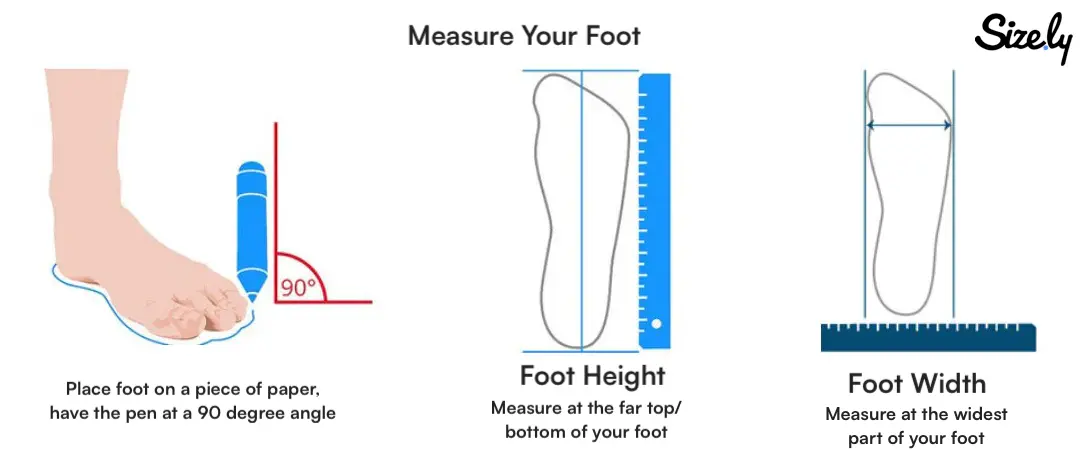
- Prepare Your Materials: Get a piece of paper larger than your foot, a pencil, and a measuring tape or ruler.
- Trace Your Foot: Place the paper on a flat, hard surface. Stand on the paper wearing the socks you intend to wear with the shoes. Hold the pencil perpendicular to the paper and trace around your foot. As a pro tip, measuring your foot width in the afternoon has some advantages, as foot width does increase a tiny bit over the day.
- Find the Widest Point: Examine the outline and identify the widest part of your foot.
- Measure the Width: Use the measuring tape or ruler to measure across the widest part of your foot tracing. Note the measurement in inches or centimeters.
- Repeat for Both Feet: Measure both feet, as one foot may be slightly wider than the other. As a general rule, if one foot is a bit wider, go with the larger measurement for both shoes.
Tips for different foot widths#
Narrow feet#
- Adjustable Closures: Choose shoes with laces, straps, or buckles to tighten the fit.
- Insoles: Adding insoles can reduce extra space inside the shoe.
- Avoid Wide Styles: Steer clear of shoes labeled as wide or extra wide.
Medium feet#
- Standard Sizes: Most medium-width shoes should fit comfortably.
- Try Them On: Since sizing can vary by brand, it's best to try shoes on before purchasing.
Wide feet#
- Wide Width Options: Look for shoes available in wide (E) or extra wide (EE) widths.
- Comfort Brands: Consider brands that specialize in comfort or orthopedic shoes, as they often offer wider sizes.
- Avoid Narrow Designs: Avoid shoes with pointed toes or narrow constructions, as those can hurt when you walk. Depending on the material of the shoe, shoes widen a bit after wearing them for a while.
Shoe width vs. shoe size#
Remember, shoe size refers to the length, while shoe width refers to the girth of the foot. Going up a size won't necessarily give you more width. If the shoe feels tight across the width but fits well in length, opt for a wider width rather than a larger size. When trying on a shoe, walk around to see if you notice any pressure on the sides of your shoe, generally if the pressure is too much, go with a wider shoe for more comfort.
Width letters also don’t transfer between men’s and women’s shoes. Women’s shoes are usually cut narrower, so if you switch, convert the size first (a women’s 10 is a men’s 8 on the women’s to men’s shoe size chart), then check the width columns in inches or centimeters for that size.
Frequently asked questions#
What does shoe width D mean?#
- Men: D is considered a standard (medium) width.
- Women: D indicates a wide width.
So for men, D is not a wide shoe: it’s the regular width most men’s shoes are sold in, fitting a foot about 3.9" / 9.9 cm across at a US 9. In women’s shoes the same letter is a wide fit.
What is shoe width B?#
- Men: B signifies a narrow width.
- Women: B is the standard (medium) width.
A women’s B is not a narrow shoe: it’s the default width most women’s shoes are sold in, fitting a foot about 3.55" / 9.0 cm across at a US 8. The narrow women’s width is A. For men, B sits two steps below the standard D, so it is a genuinely narrow fit.
Shoe width B vs D: what’s the difference?#
Two width steps. On the women’s chart a D is about 0.4" / 1 cm wider than a B at the same size: at a US women’s 8, B fits a 3.55" / 9.0 cm foot and D fits 3.95" / 10.0 cm. In men’s shoes B is narrow and D is the standard width, so a man who normally wears D will find a B tight.
What is considered a narrow foot for women?#
An A width or smaller. At a US women’s 8, a narrow (A) foot measures about 3.2" / 8.1 cm across the widest point, compared with 3.55" / 9.0 cm for a medium (B). If your measurement comes in noticeably under the B column for your size in the women’s chart above, look for shoes labeled A, N or narrow.
What is considered a wide foot for a man?#
Anything past the standard D: E is wide, EE (2E) extra wide, 4E ultra wide. At a US men’s 9, an E width fits a foot about 4.1" / 10.4 cm across, versus 3.9" / 9.9 cm for a D. If your foot measures more than the D column for your size in the men’s chart above, start with an E.
What is shoe width EE (2E)?#
EE, also written 2E, is an extra wide width in men’s shoes, one step wider than E. In women’s shoes, extra wide is labeled E on the chart above; some brands use 2E there too.
Shoe width D or EE: what’s the difference?#
- D width: Standard width for men; wide for women.
- EE width: Extra wide for men; wider than D.
EE is two width steps up from D (D, then E, then EE), roughly 0.4" / 1 cm of extra room across the ball of the foot. If a D presses at the sides but the length is right, try E before jumping to EE.
How wide is a D width shoe?#
It depends on the length. On the men’s chart, D runs from 3.4" / 8.6 cm at a US 5 up to 4.3" / 10.9 cm at a US 12; around the common sizes 9 to 10 it’s 3.9–4.0" / 9.9–10.2 cm. On the women’s chart, where D counts as wide, it runs from 3.55" / 9.0 cm at a US 5 to 4.45" / 11.3 cm at a US 12.
How do I know if I need a wide width shoe?#
If your shoes feel tight across the width, or you notice stretching and bulging on the sides, you may need a wider shoe.
Getting the width right#
Length and width are separate measurements: going up a size adds length, not width. Measure both feet, use the charts above, and check whether the brand offers your width before you buy; this matters most for running and sports shoes, where a too-narrow fit hurts long before the shoe breaks in. If you shop across brands, the shoe size recommender matches your size across 400+ brands. The best shoe feels comfortable from the moment you put it on, no breaking in required.






Make the right size obvious.
Join 85,000+ sellers showing measurements buyers trust. Free to start. No credit card.