
Bra Size Conversion Chart
Convert bra sizes between US, UK, EU, French and Japanese sizing: cups match through D, so US 34B = UK 34B = EU 75B = JP B75. Band and cup charts plus a calculator.
Last updated June 2026
Bra size conversion at a glance#
A bra size is a band number plus a cup letter, and both change between countries. US and UK share the same inch-based band numbers, while European and Japanese bands are in centimeters and French and Spanish bands run 15 above the European number. Cup letters match through D, then diverge.
| US / UK Band | Europe | France / Spain | Japan | Australia |
|---|---|---|---|---|
| 28 | 60 | 75 | 60 | 6 |
| 30 | 65 | 80 | 65 | 8 |
| 32 | 70 | 85 | 70 | 10 |
| 34 | 75 | 90 | 75 | 12 |
| 36 | 80 | 95 | 80 | 14 |
| 38 | 85 | 100 | 85 | 16 |
| 40 | 90 | 105 | 90 | 18 |
| 42 | 95 | 110 | 95 | 20 |
| 44 | 100 | 115 | 100 | 22 |
| 46 | 105 | 120 | 105 | 24 |
| 48 | 110 | 125 | 110 | 26 |
To read across: a US 34 band is a UK 34, a European 75, a French or Spanish 90, a Japanese 75 and an Australian 12. Cups stay the same through D, so a US 34B is a UK 34B, a European 75B and a Japanese B75. Above D the US doubles up (DD, DDD/E), so a US D is a UK DD and a European E, and a US 36DD reads as a European 80E. To convert a bust measurement to centimeters, multiply inches by 2.54: a 34 in bust is 86 cm and a 36 in bust is 91 cm.
How do Japanese bra sizes convert to US sizes? Japanese sizes put the cup letter first and the band in centimeters, like B70 or C75. Convert the band with the table above (JP 70 = US 32, JP 75 = US 34, JP 80 = US 36); cup letters match through D, so a Japanese C is a US C. A Japanese C75 is a US 34C, and a Japanese E80 is a US 36DD, because the European and Japanese E equals the US DD.
What is an A9 bra size? A9 is not a standard size in any system on this chart. Japanese bras pair a cup letter with a band in centimeters, written cup first: A65, A70, A75. When A9 or 9A appears on a Japanese tag, the 9 usually refers to Japanese women's clothing size 9, roughly a US small to medium, worn with an A cup. The bra size itself would read like A70.
These conversions are compiled from the page's own cup and band tables below, which align with the Sizely bra size calculator across every system shown. Sizes still vary by brand and cut, so when a brand publishes its own guide, trust it, and measure your band and bust where you can. For clothing rather than lingerie, see the women's international size conversion chart and the international dress size conversion chart.
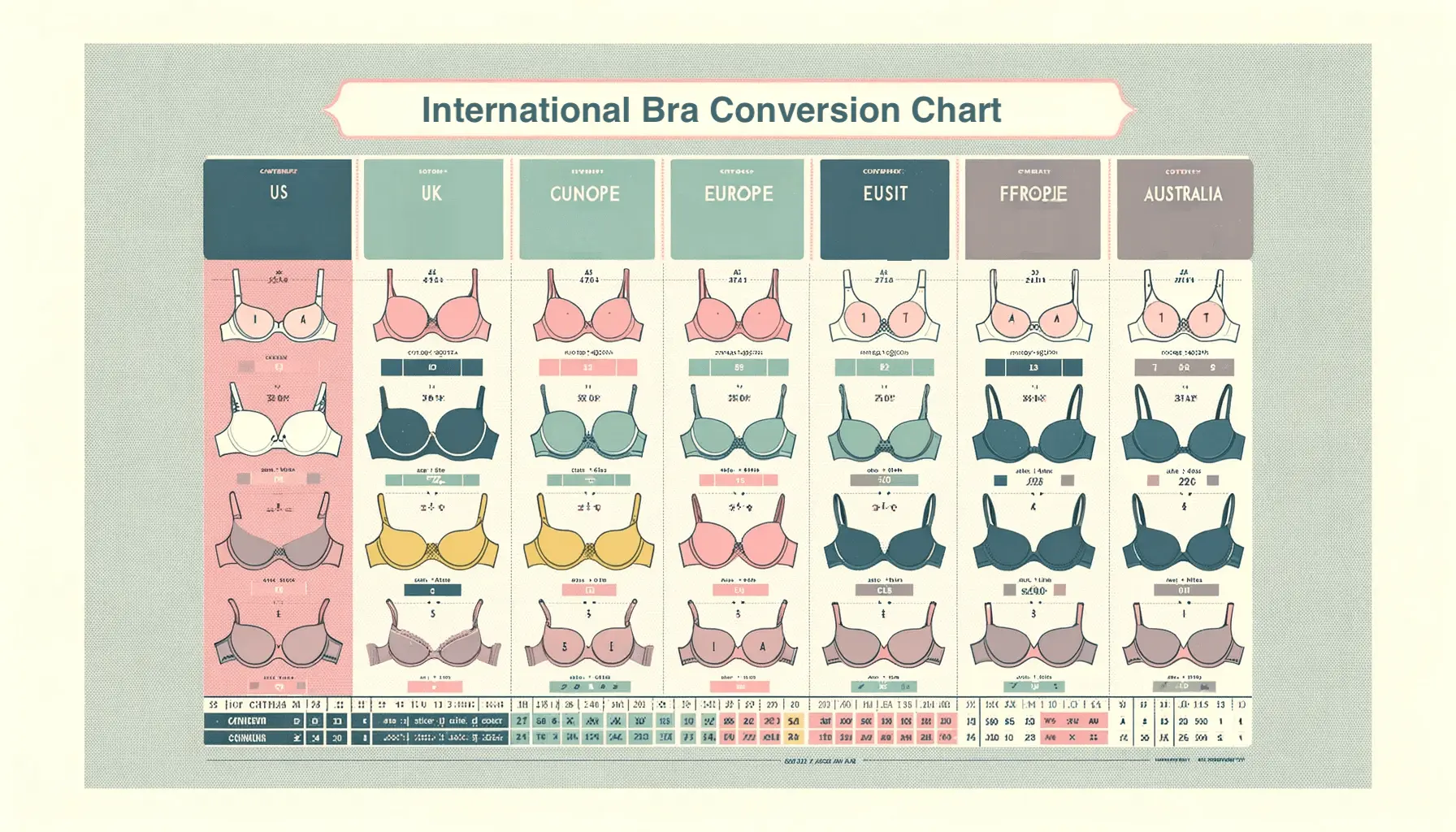
This chart converts bra sizes between the United States, United Kingdom, Europe, France, Spain, Japan and Australia: one table for cup letters, one for band numbers. For automatic conversions you can also use our bra size calculator. If you are converting clothing rather than lingerie, see the women's international size conversion chart and the international dress size conversion chart.
How to use the chart#
- Find your US size: locate your US bra size on the chart, a number (band size) plus a letter (cup size).
- Compare and convert: read across the row to find the matching size in the UK, Europe, France, Spain, Japan and Australia.
- Watch the cup letters: band sizes convert cleanly, but cup letters shift between systems. On this chart a US D lines up with a UK DD and a European E, so the same letter does not mean the same cup.
Key points to remember#
- Band sizes: US and UK share the same inch-based band numbers. European and Japanese bands are in centimeters (US 34 = EU 75), and French and Spanish bands run 15 above the European number (EU 75 = FR 90).
- Cup sizes: cups don't follow a straight alphabetical run after D (US: DD, DDD/E, then F), so convert with the cup table rather than assuming the next letter.
- Check the brand's guide: brands cut differently, so when a brand publishes its own size chart, trust it over any general conversion.
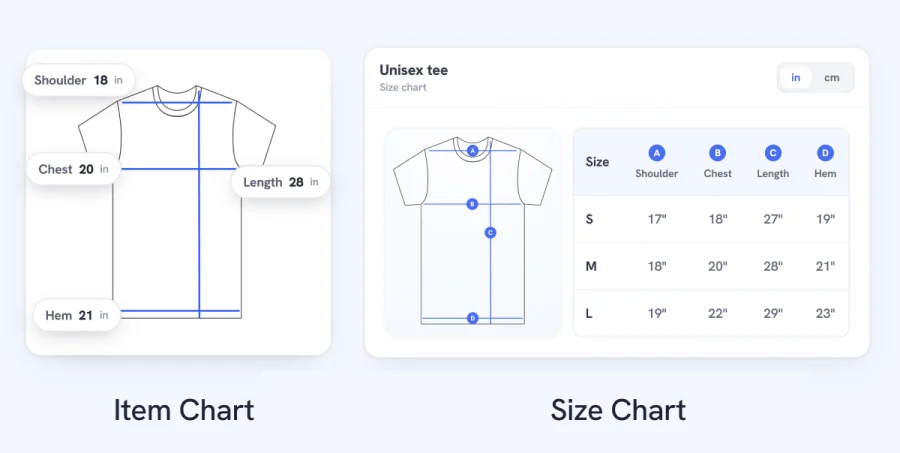
Put exact measurements on every listing, whether you sell on eBay, Shopify, or your own store.
Create your free size chart
Every garment measured in 0.92 seconds, with pro photos, labels, and descriptions, from your iPhone.

Cup size converter: US, UK, Europe, France/Spain, Japan & Australia#
| USA | UK | Europe | France/Spain | Japan | Australia |
|---|---|---|---|---|---|
| AA | AA | AA | AA | AA | AA |
| A | A | A | A | A | A |
| B | B | B | B | B | B |
| C | C | C | C | C | C |
| D | D | D | D | D | D |
| DD | DD | E | E | E | DD |
| DDD/E | E | F | F | F | E |
| F | F | G | G | G | F |
| G | G | H | H | H | G |
| H | H | I | I | I | H |
| I | I | J | J | J | I |
How to measure your bra size#
Tools needed
A measuring tape and a mirror.
Band measurement
Stand in front of a mirror and wrap the tape around your body, right underneath your breasts. Keep the tape horizontal and snug. The measurement in inches is your band size. If you land between sizes, say 41 inches (104 cm), try both a 40 and a 42.
Cup measurement
Measure around the fullest part of your bust, then subtract your band measurement from your bust measurement. The difference sets your cup size.
Here is an example:
Cup size = bust size - band size
Up to 4" (10 cm) = AA, 4-5" (10-13 cm) = A, 5-6" (13-15 cm) = B, 6-7" (15-18 cm) = C, 7-8" (18-20 cm) = D, 8-9" (20-23 cm) = DD, 9-10" (23-25 cm) = DDD/E. Above that, letters diverge by country, so use the cup table to convert.
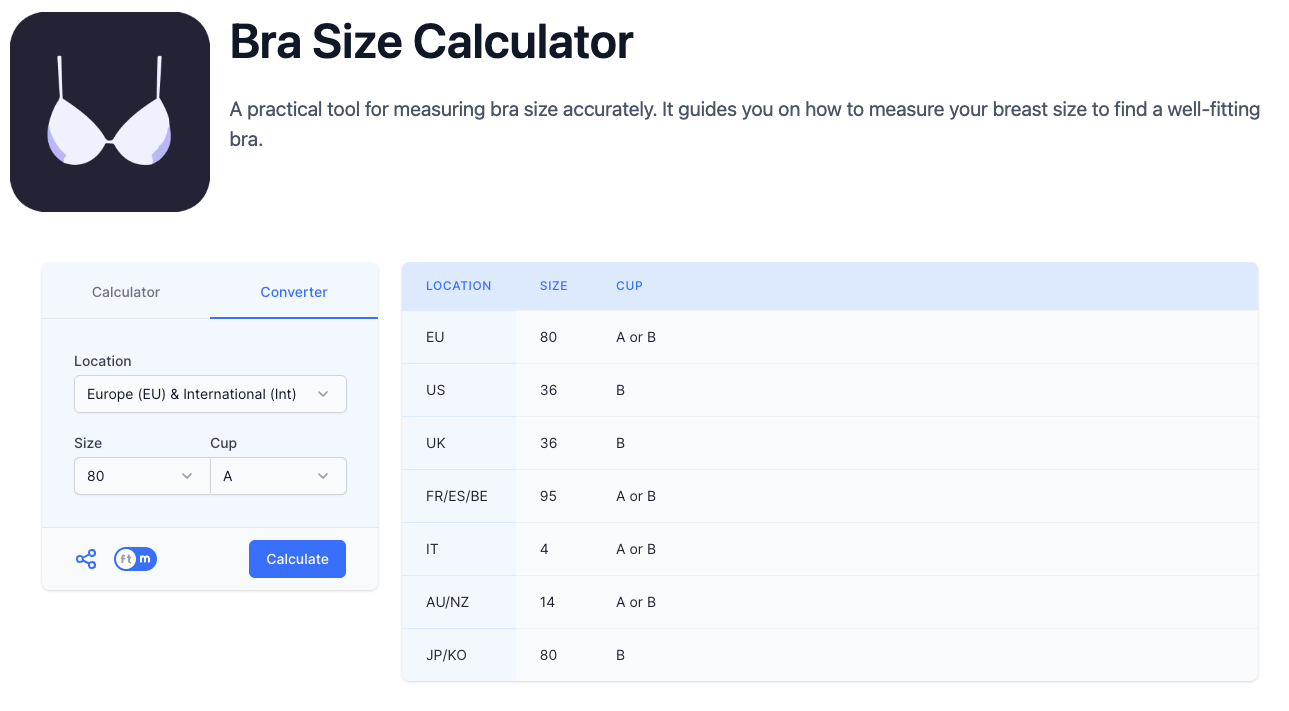
Bra size calculator
Our bra size calculator does this math for you and converts the result across all the international systems on this page.
How to measure your bra size (video)#
Band size converter: US, UK, Europe, France/Spain, Japan & Australia#
| USA | UK | Europe | France/Spain | Japan | Australia |
|---|---|---|---|---|---|
| 28 | 28 | 60 | 75 | 60 | 6 |
| 30 | 30 | 65 | 80 | 65 | 8 |
| 32 | 32 | 70 | 85 | 70 | 10 |
| 34 | 34 | 75 | 90 | 75 | 12 |
| 36 | 36 | 80 | 95 | 80 | 14 |
| 38 | 38 | 85 | 100 | 85 | 16 |
| 40 | 40 | 90 | 105 | 90 | 18 |
| 42 | 42 | 95 | 110 | 95 | 20 |
| 44 | 44 | 100 | 115 | 100 | 22 |
| 46 | 46 | 105 | 120 | 105 | 24 |
| 48 | 48 | 110 | 125 | 110 | 26 |
Bra size conversion FAQs#
How do I find my bra size using the international conversion chart?#
To find your bra size using the international conversion chart, start by knowing your current bra size in the US system, which includes your band size (a number) and your cup size (a letter). Then, locate your US bra size on the conversion chart to see how it translates into UK, European, France/Spain, Japan, and Australian sizes. Band sizes are more uniform across countries; cup sizes shift more, so check both the band and cup columns.
Why do cup sizes vary so much between countries, and how can I ensure I'm choosing the right size?#
Cup sizes vary between countries due to different sizing standards and methods of measurement. For example, after the size 'D', countries may not follow the same alphabetical sequence for cup sizes. To get the right size, follow the brand's own measuring instructions and convert with the table for that country's system. The bra size calculator or a professional fitting can confirm the result.
What's the best way to measure my band size at home?#
The best way to measure your band size at home is by standing in front of a mirror with a measurement tape. Wrap the tape directly under your breasts, where the band of your bra would sit. Ensure the tape is horizontal around your body and snug but not too tight. Read the measurement in inches: this is your band size. If your measurement is an odd number or falls between sizes, consider trying both adjacent sizes for the best fit.
How do I calculate my cup size correctly?#
To calculate your cup size, first measure around the fullest part of your breast to get your bust size. Then, subtract your band measurement (measured underneath the breasts) from your bust measurement. The difference determines your cup size: 4-5 inches (10-13 cm) is an A cup, 5-6 inches (13-15 cm) a B, 6-7 inches (15-18 cm) a C and 7-8 inches (18-20 cm) a D.
Can I use the same conversion chart for all brands and types of bras?#
The international bra size conversion chart is a starting point, but sizes vary by brand and bra style. Always consult the specific brand's size guide or customer service for the most accurate sizing, especially for styles like sports bras, push-up bras, or bras made with unique materials.
What should I do if my converted bra size doesn't seem to fit well?#
If your converted bra size doesn't seem to fit well, consider a few factors: the brand's specific sizing, the style of the bra, and your own body's changes over time. It might be helpful to get a professional fitting in-store, try different sizes around your converted size (one size up or down in band or cup), or reach out to the brand's customer service for advice.
How often should I re-measure my bra size?#
It's recommended to re-measure your bra size at least once a year or after any significant changes to your body, such as weight fluctuations, pregnancy, or changes in exercise habits. Regularly updating your measurements ensures you're always wearing the right size for optimal comfort and support.
What is a J cup?#
It depends on the country. A European, French or Japanese J cup is the largest size on this chart and converts to a US I. J is near the top of the scale, where the US doubles letters (DD, DDD) and Europe runs straight through the alphabet, so the gap between systems is widest. Letters this far up also vary by brand, so convert through the table instead of matching letters.
What does a bra size like 42/95 or 46/105 mean?#
That is a dual label showing the same band in two systems: the US/UK band in inches and the European band in centimeters. On the band table, US 42 = EU 95, US 46 = EU 105, US 40 = EU 90 and US 48 = EU 110. A label like 32/70 A/B works the same way (US 32 = EU 70), with A/B meaning the cup sits between the two letters. Numbers like 165/90 are different: that is Chinese garment sizing, height and chest in centimeters, not a band and cup.
How do I convert my bust size to cm?#
Multiply inches by 2.54: a 36-inch bust is 91 cm and a 34-inch bust is 86 cm. Band numbers on European and Japanese labels are already in centimeters, so a US 34 band reads as 75 on an EU or Japanese label.
What order do bra cup sizes go in?#
US cups run AA, A, B, C, D, DD, DDD/E, F, G, H, I, doubling up the D before continuing. UK and Australian cups match the US through D, then keep going DD, E, F, FF, G, GG as the letters climb. European, French and Japanese cups run straight from A to K with no double letters, which is why their letter sits ahead of the US one above a D cup. Bands go up in steps of two in the US and UK (28 to 48) and steps of five in Europe and Japan (60 to 110).
You might also like






Make the right size obvious.
Join 85,000+ sellers showing measurements buyers trust. Free to start. No credit card.