

Army Body Fat Calculator
Army body fat calculator: check your waist-to-height ratio against the Army's 2026 standard of below 0.55, plus a body fat estimate with the former tape test.

Written by
Annie Button
Updated
There was an error with your calculation.
YOUR WAIST-TO-HEIGHT RATIO
0.517
You meet the Army standard: a waist-to-height ratio below 0.55. Recorded as the Army does: waist 37 in, height 71.5 in.
MULTI-SITE TAPE TEST BODY FAT (RETIRED METHOD)
15%
Multi-site tape test estimate (AR 600-9). Army Directive 2023-11 replaced this method with a one-site tape test between June 2023 and June 2024, and the body fat limits ended in July 2026. The limit for your age was 24% for males and 34% for females, and this result is within it.
| OLD AR 600-9 BODY FAT LIMITS TO JOIN (BEFORE JULY 2026) | ||
|---|---|---|
| Age | Male | Female |
| 17-20 | 24% | 30% |
| 21-27 | 26% | 32% |
| 28-39 | 28% | 34% |
| 40 and over | 30% | 36% |
| OLD AR 600-9 BODY FAT LIMITS AFTER ENTRY (BEFORE JULY 2026) | ||
|---|---|---|
| Age | Male | Female |
| 17-20 | 20% | 30% |
| 21-27 | 22% | 32% |
| 28-39 | 24% | 34% |
| 40 and over | 26% | 36% |

Army body fat calculator at a glance#
How does the Army measure body composition now?#
Since July 2026, the Army uses your waist-to-height ratio instead of a body fat percentage. Army Directive 2026-13 makes the ratio the only measurement for all soldiers, and the standard is a ratio below 0.55. Height and weight screening tables are discontinued.
What does this calculator measure?#
Its main result is your waist-to-height ratio, worked out the way the Army records it, with a check against the 0.55 standard. Below that it estimates body fat with the multi-site tape method of AR 600-9 (neck, waist and height for men, plus hips for women), which Army Directive 2023-11 replaced with a one-site tape test between June 2023 and June 2024. It compares that estimate with the body fat limit for your age group, which applied until July 2026. Your unit's official measurement is what counts.
How do you calculate your waist-to-height ratio?#
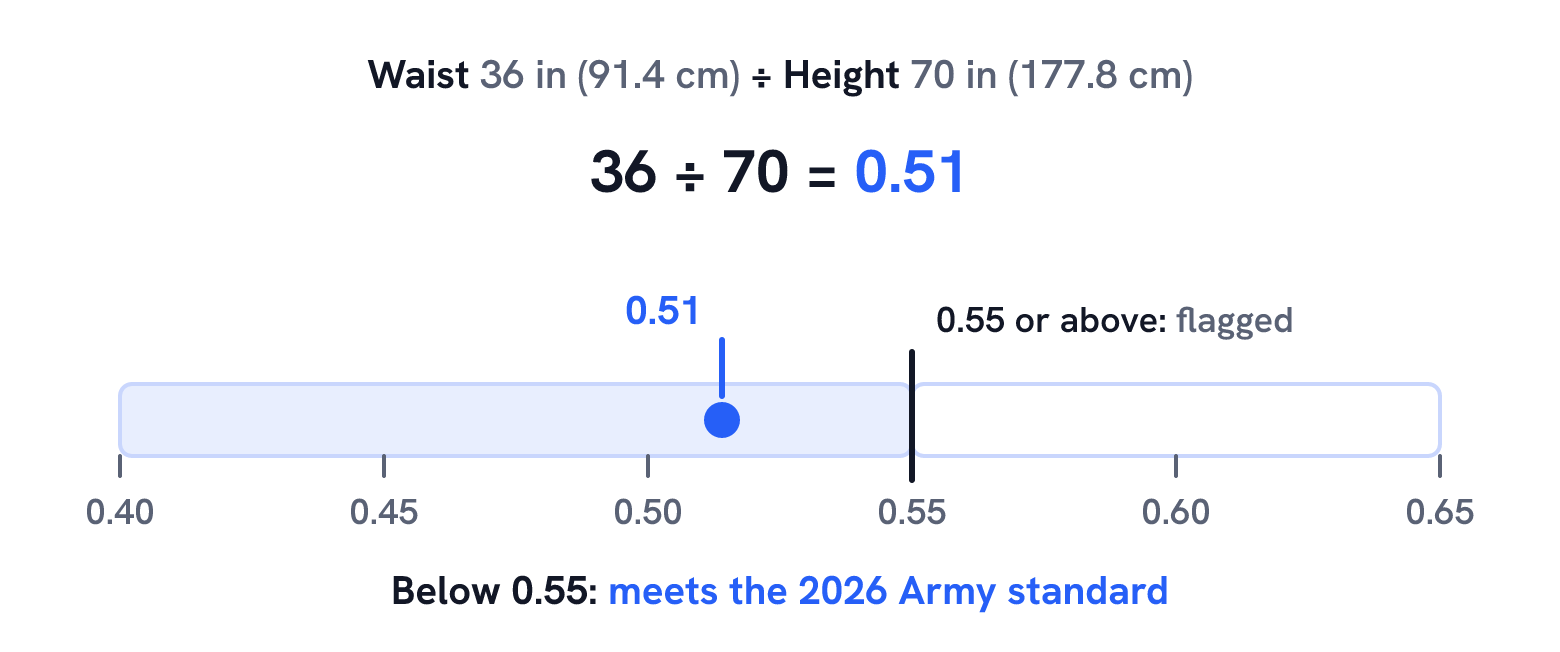
Divide your waist, measured at the navel, by your height, both in inches. A soldier with a 36 in (91.4 cm) waist who is 5 ft 10 in (70 in, 177.8 cm) tall has a ratio of 36 ÷ 70 = 0.514. That's below 0.55, so it meets the 2026 standard. The Army records the waist rounded down to the nearest half inch and the height rounded to the nearest half inch, then keeps three decimals without rounding, so 0.549 passes and 0.550 fails. The calculator does the same.
How Army body composition testing changed#
The Army has changed its method twice since 2023. If you're reading an old guide or using an old calculator, check which period it describes.
| Period | Method | Standard |
|---|---|---|
| Before 2023 | AR 600–9 (2019): height and weight screening, then a multi-site tape test (neck and waist for men, neck, waist and hips for women) | Maximum body fat by age group and sex |
| 2023 to July 2026 | Army Directive 2023–11: a one-site tape test around the abdomen | Body fat percentage |
| From July 2026 | Army Directive 2026–13: waist-to-height ratio only | A ratio below 0.55 for every soldier |
The calculator's main result uses the third method, the one the Army uses now. Its body fat estimate uses the first.
How the calculator works#
The waist-to-height ratio is one division, covered in the 2026 section below. The body fat estimate, the second result, comes from the tape method, which estimates body fat from circumferences. James Hodgdon built these equations from measurements of Navy sailors at the Naval Health Research Center. A 2022 paper in Frontiers in Physiology notes that the armed services later settled on them as one shared set. The calculator uses the centimeter form and converts any inches you type (1 in = 2.54 cm):
- Men: density = 1.0324 − 0.19077 × log10(waist − neck) + 0.15456 × log10(height)
- Women: density = 1.29579 − 0.35004 × log10(waist + hips − neck) + 0.22100 × log10(height)
- Body fat % = 495 ÷ density − 450
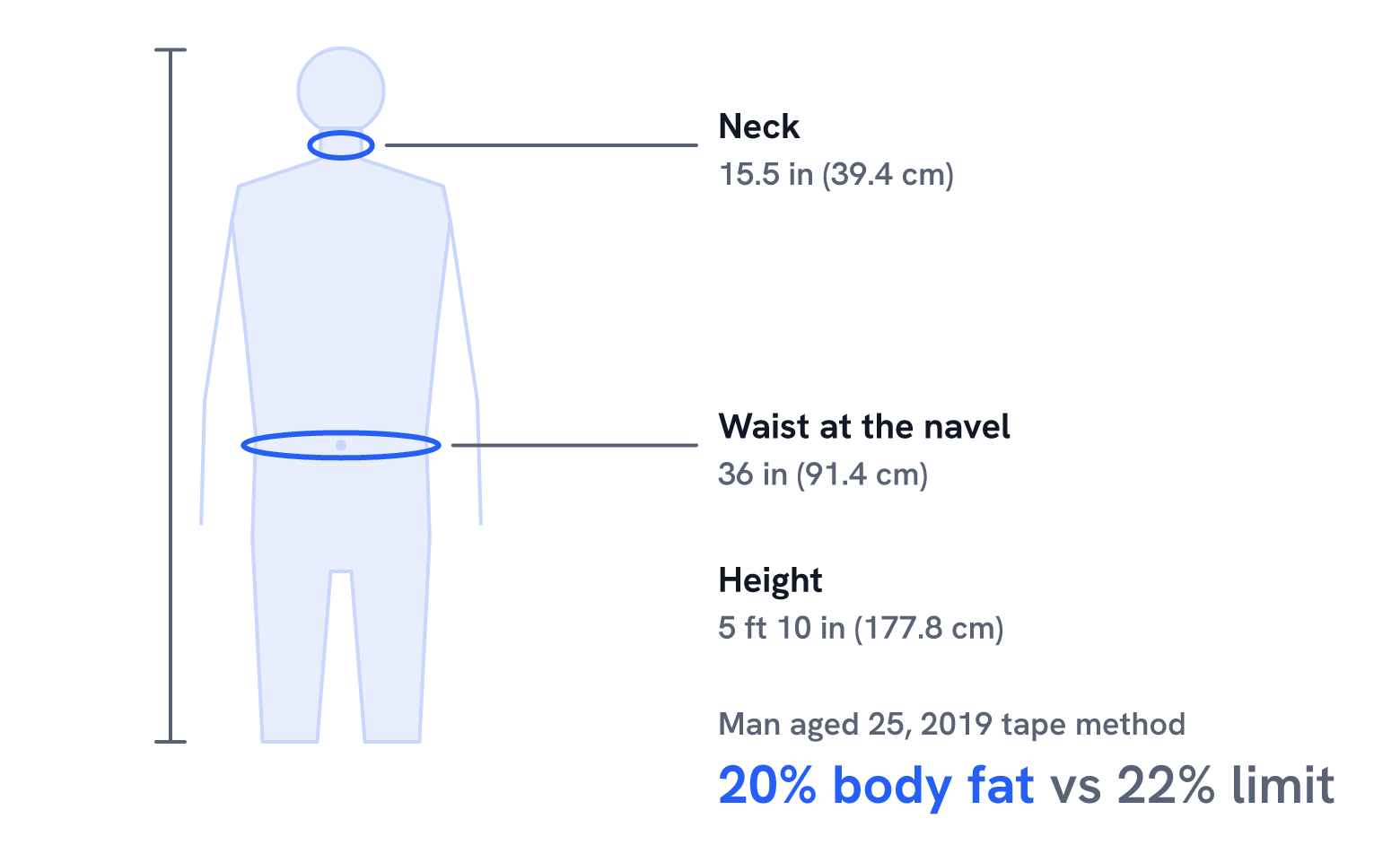
One example runs through this page: a 25-year-old man, 5 ft 10 in (177.8 cm) tall, with a 15.5 in (39.4 cm) neck and a 36 in (91.4 cm) waist. Worked by hand:
- Subtract the neck from the waist: 91.44 − 39.37 = 52.07 cm.
- Take the base 10 logarithms: log10(52.07) = 1.7166 and log10(177.8) = 2.2499.
- Find the density: 1.0324 − 0.19077 × 1.7166 + 0.15456 × 2.2499 = 1.0527.
- Convert to body fat: 495 ÷ 1.0527 − 450 = 20.2%.
The calculator shows 20%. His age group's limit under the 2019 tables was 22%, so it reports the estimate as within the old limit. His waist-to-height ratio, the number the Army checks now, is 0.514.
How to measure for the tape method#
The sites follow the Army's former tape test. Stand straight, relax, and breathe out normally before each reading. It's much easier if a partner wraps a tape around each spot for you and keeps it level and snug on bare skin.
- Neck: just under the larynx (Adam's apple), perpendicular to the long axis of the neck.
- Abdomen for men: level with the navel.
- Waist for women: at the point where the abdomen is smallest.
- Hips for women: over the buttocks where they stick out the most.
- Height: in bare feet, standing straight.
The 2019 body fat limits the calculator compares#
The calculator compares its body fat estimate with the maximum allowed for your age group under AR 600-9 (2019). It rounds the estimate to a whole percent and compares that same number, so a result shown as 22% is within a 22% limit. Age groups go by whole years, so 20 and a half counts as 20.
| Age Group | Men | Women |
|---|---|---|
| 17–20 | 20% | 30% |
| 21–27 | 22% | 32% |
| 28–39 | 24% | 34% |
| 40 and older | 26% | 36% |
The calculator also lists a separate table of entry limits for recruits. Entry standards can differ from the ones that apply once you serve, so a recruiter can tell you which numbers apply when you enlist.
The 2026 waist-to-height standard#
Army Directive 2026-13 was signed on 1 July 2026 and took effect immediately. Here's what it sets:
- The waist-to-height ratio is the only body composition measurement for all soldiers.
- The standard is a ratio below 0.55. A soldier at 0.55 or above is flagged and enrolled in the Army Body Composition Program.
- The waist is measured at the navel. The Army records it rounded down to the nearest half inch and the height rounded to the nearest half inch, and keeps the ratio to three decimals without rounding, so 0.549 passes and 0.550 fails.
- Before any action, a different team takes a confirmation measurement on the same duty day.
- Every soldier is measured at least twice per calendar year. Commanders allow at least 7 days between a fitness test and the measurement unless urgent operational needs require otherwise.
- No fitness test score exempts a soldier, and no tape test or other body fat assessment can be used to challenge the result.
The same standard applies at every age and to men and women. It covers the Regular Army, the Army National Guard, the Army Reserve, and cadets at West Point and in Senior ROTC.
The calculator above works out this ratio as its main result. For the example soldier, 36 ÷ 70 = 0.514, comfortably below 0.55. At 70 in tall, his waist would have to stay under 0.55 × 70 = 38.5 in (97.8 cm). A waist recorded at 38.5 in gives exactly 0.550, which fails.
The table below shows that limit for common heights. It's simple arithmetic, not an official Army chart, and your unit measures the waist to the Army's own procedure.
| Height | Waist Must Stay Under |
|---|---|
| 5 ft 0 in (152.4 cm) | 33.0 in (83.8 cm) |
| 5 ft 2 in (157.5 cm) | 34.1 in (86.6 cm) |
| 5 ft 4 in (162.6 cm) | 35.2 in (89.4 cm) |
| 5 ft 6 in (167.6 cm) | 36.3 in (92.2 cm) |
| 5 ft 8 in (172.7 cm) | 37.4 in (95.0 cm) |
| 5 ft 10 in (177.8 cm) | 38.5 in (97.8 cm) |
| 6 ft 0 in (182.9 cm) | 39.6 in (100.6 cm) |
| 6 ft 2 in (188.0 cm) | 40.7 in (103.4 cm) |
| 6 ft 4 in (193.0 cm) | 41.8 in (106.2 cm) |
| 6 ft 6 in (198.1 cm) | 42.9 in (109.0 cm) |
This gives an estimate, not medical advice. A doctor can tell you what the number means for you, and only your unit's official measurement decides whether you meet the standard.
Body fat, BMI and waist size#
Waist-to-height ratio is a screening measure, not a body fat reading. Human Performance Resources by CHAMP (HPRC), part of the Uniformed Services University, notes that it's well established for flagging risk factors such as high blood pressure and diabetes. It also calls the ratio better at predicting them than waist size or BMI alone.
If you want an actual body fat estimate, the body fat percentage calculator offers the same Navy tape equations plus a BMI-based formula, with fat and lean mass. Your BMI itself is on the BMI calculator, and the ideal weight calculator gives weight ranges for your height.
Sources#
- Army Directive 2026-13, Army Body Composition Program and Standards, signed 1 July 2026
- U.S. Army, Army Body Composition Program and Standards FAQ (three decimals, no rounding, waist at the navel)
- U.S. Army, EXORD 182-26 Annex A, waist-to-height ratio measurement procedures
- Association of the United States Army, Army Updates Body Composition Policy, July 2026
- Human Performance Resources by CHAMP (HPRC), Uniformed Services University, How the military measures body composition
- Potter and colleagues, Circumference-Based Predictions of Body Fat Revisited: Preliminary Results From a US Marine Corps Body Composition Survey, Frontiers in Physiology, 2022
Frequently asked questions#
Does the Army still use the tape test?#
Not for its body composition standard. Since Army Directive 2026-13, the waist-to-height ratio is the only measurement, and a tape test or other body fat assessment can't be used to challenge it. The one-site tape test from 2023 was rescinded by the same directive.
What happens if my waist-to-height ratio is 0.55 or higher?#
A second team measures you again on the same duty day. If the result stands, you're flagged and enrolled in the Army Body Composition Program. For Regular Army and Active Guard Reserve (AGR) soldiers, the commander then requests a medical exam to rule out an underlying condition. Guard and Reserve soldiers can ask for one, at their own expense when not on active duty. No soldier is separated until Army headquarters completes a 180-day assessment and issues further guidance.
Can a high fitness test score exempt me from the standard?#
No. The 2026 directive says no fitness test score exempts a soldier from the waist-to-height standard. It also rescinded the earlier exemptions for high scores: Army Directive 2023-08 for the ACFT and Army Directive 2025-17, which exempted soldiers scoring 465 or more on the Army Fitness Test with at least 80 points in each event.
What was the one-site tape test?#
Army Directive 2023-11 replaced the multi-site test with a single tape measurement around the abdomen, phased in from 2023. It was in use until the 2026 directive replaced it with the waist-to-height ratio.
What were the old Army body fat limits for women?#
Under AR 600-9 (2019) the maximum for women was 30% at ages 17 to 20, 32% at 21 to 27, 34% at 28 to 39 and 36% at 40 and older. The calculator still compares its multi-site tape estimate with these when you choose Female.
How often are soldiers measured?#
Every soldier is measured at least twice per calendar year. Commanders allow at least 7 days between a fitness test and the measurement unless urgent operational needs require otherwise.
Related calculators
View all calculators Bra Size CalculatorBra size calculator: turn your underbust and bust measurements into a bra size in US, UK, EU and four more systems, or convert a size between countries.
 Calorie CalculatorCalorie calculator: estimate your daily maintenance calories and the calories to lose or gain 0.5 to 2 lb a week, plus a calories to joules converter.
 Calories Burned CalculatorCalories burned calculator: estimate calories burned walking, running or cycling from your weight and time, or from distance and pace in miles.
 Ideal Weight CalculatorIdeal weight calculator: estimate ideal body weight from height and sex with the Hamwi, Devine, Robinson and Miller formulas, plus a healthy BMI range.
 Ovulation CalculatorOvulation calculator: estimate your ovulation date, fertile window and next period from the first day of your last period and your average cycle length.
 Period CalculatorPeriod calculator: predict your next periods on a three-month calendar and a six-cycle table, from the first day of your last period and your cycle length.