

Cubic Yards Calculator
Cubic yards calculator for mulch, soil, gravel and concrete: enter the size and depth of a rectangle, circle, ring or triangle to get cubic yards and feet.

Written by
Annie Button
Updated
Preview Cubic Yards Calculator Widget
There was an error with your calculation.
| Result | |
|---|---|
| Cubic Yards | 0.29834 yd³ |
| Cubic Feet | 8.05511 ft³ |
| Cubic Meters | 0.2281 m³ |
| Price | 2.98337 $ |
Cubic yards calculator at a glance#
What is a cubic yard?#
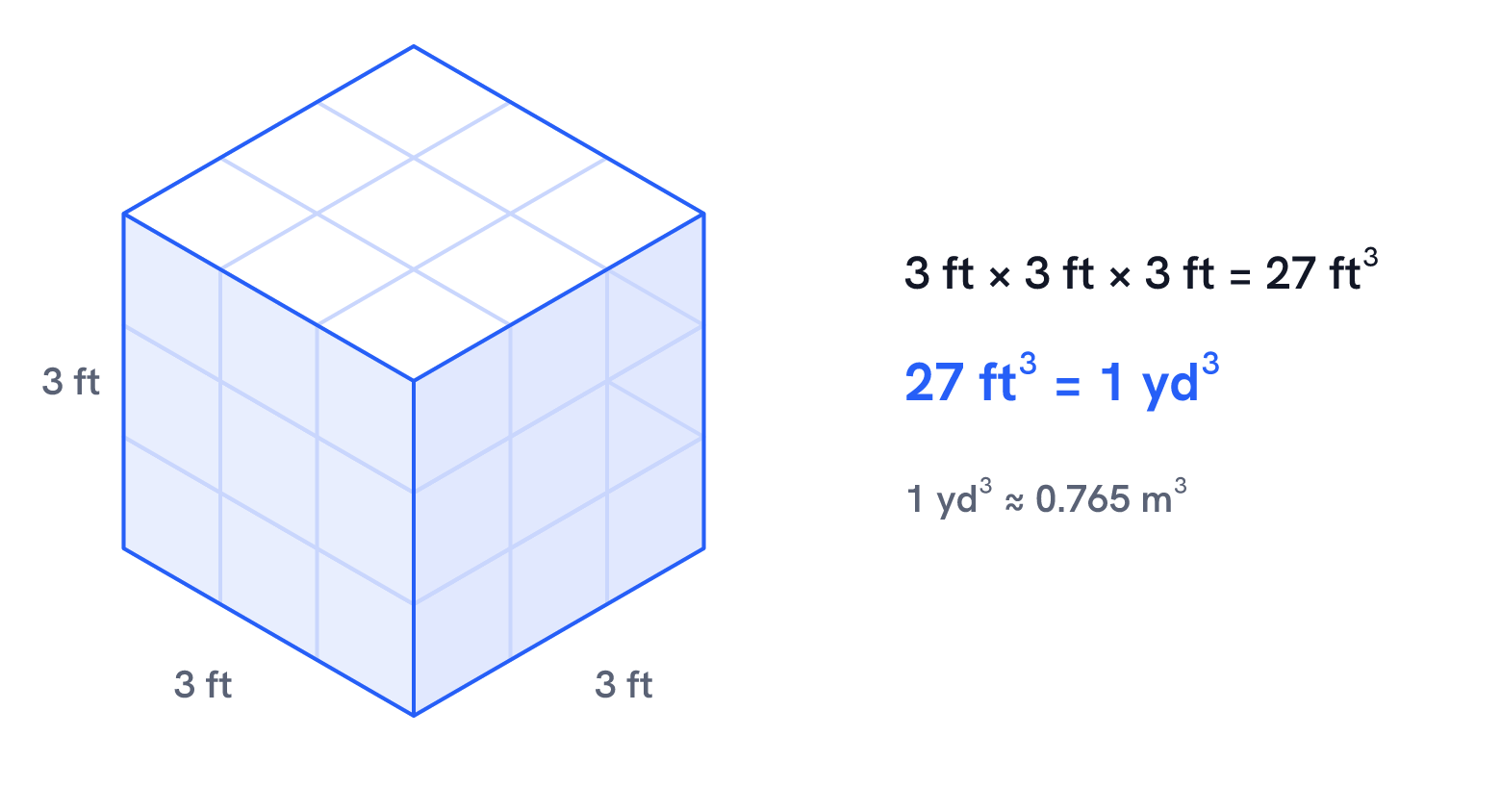
A cubic yard is the volume of a cube that measures 1 yard, or 3 feet, on each edge. This is 3 × 3 × 3 = 27 cubic feet. According to NIST Handbook 44, 27 cubic feet is exactly 1 cubic yard, which is about 0.765 cubic meters. It's written as yd3, cu yd, or CY.
How do you calculate cubic yards?#
To find cubic yards, multiply the length and width in feet by the depth in feet to get cubic feet, then divide by 27. Since depth is usually measured in inches, divide it by 12 first. The formula is: cubic yards = length (ft) × width (ft) × depth (in) ÷ 12 ÷ 27.
How many cubic yards do I need for 2,000 square feet?#
The cubic yards needed depend on the depth. For 3 inches deep, 2,000 square feet needs 2,000 × 3 ÷ 12 ÷ 27, which is about 18.52 cubic yards. At 2 inches deep, it requires about 12.35 cubic yards, and at 4 inches, approximately 24.69 cubic yards.
How to calculate cubic yards by hand#
Take a garden bed 12 feet long and 10 feet wide that needs mulch 3 inches deep. First, find the area, which is 12 × 10 = 120 square feet. Next, convert the depth into feet: 3 ÷ 12 = 0.25 feet. Then, multiply these to get 120 × 0.25 = 30 cubic feet. Finally, divide by 27 to find 30 ÷ 27 ≈ 1.11 cubic yards.
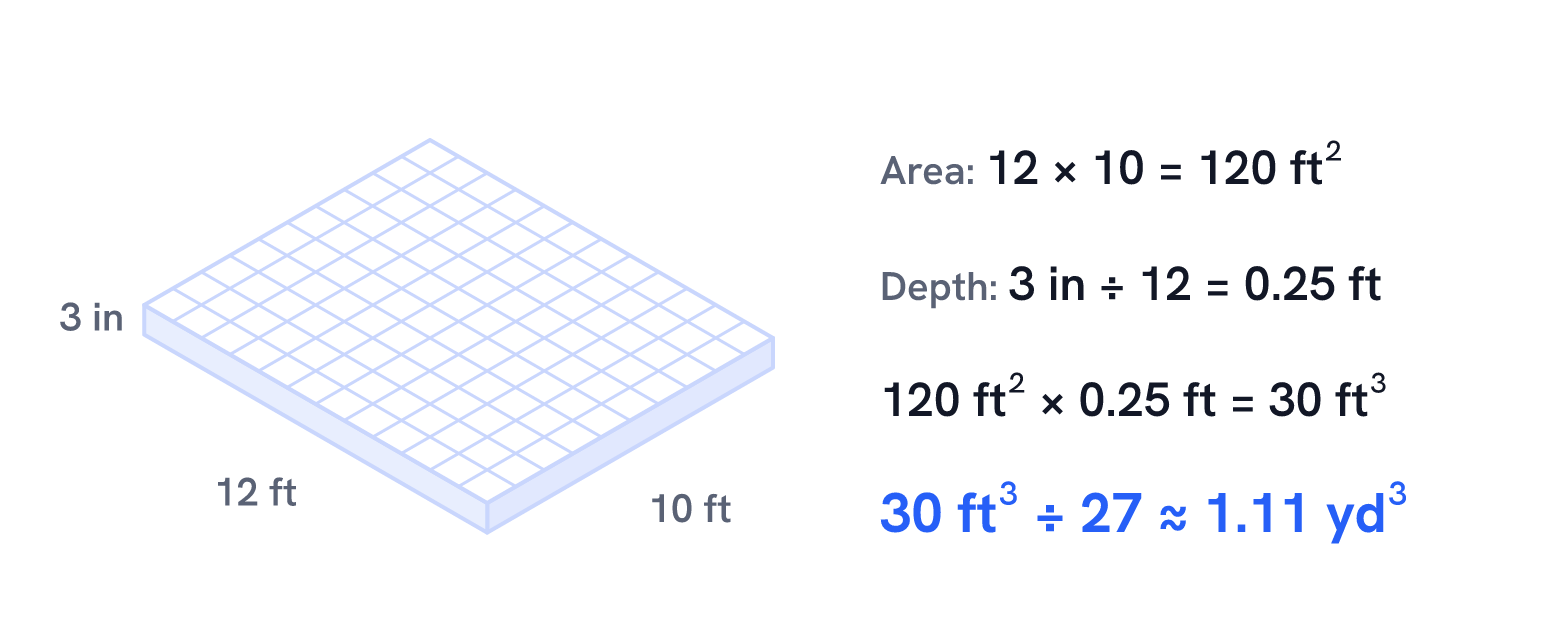
If you're pouring a concrete slab of the same size with a thickness of 4 inches, you'd use the same method. The result would be 120 × 4 ÷ 12 = 40 cubic feet and 40 ÷ 27 ≈ 1.48 cubic yards.
Why 27 and not 3? A yard is 3 feet, so a cubic yard measures 3 feet long, 3 feet wide, and 3 feet high, which is a stack of 27 one-foot cubes. A common mistake is dividing cubic feet by 3, as if converting feet to yards. This error makes the calculation 9 times too large: the garden bed would seem to be 10 cubic yards instead of 1.11.
How to use the calculator#
Select the shape of the area you're working with, then input its dimensions and depth. The calculator processes measurements in inches, with an option to switch to centimeters if needed, so remember to convert any measurements in feet to inches before entering them. For instance, if you're working with a garden bed, input the 12 foot side as 144 inches, the 10 foot side as 120 inches, and the depth as 3 inches. The calculator will provide an output of approximately 1.11 cubic yards, 30 cubic feet, and 0.85 cubic meters.
The available shape options include:
- For a square, you need one side and the depth.
- For a rectangle, input the length, width, and depth.
- A rectangle border requires the inner length and width, along with the border width, which is useful for creating a strip of gravel or mulch around areas like a bed, patio, or pool.
- For a circle, enter the diameter and the depth. For a mulch ring around a tree, use the ring tab with the outer and inner diameters.
- A ring requires both the outer and inner diameters to determine the space between two circles.
- For a triangle, input all three sides, with the area calculated using Heron's formula.
- A trapezoid requires the two parallel sides and the distance between them.
If you want to estimate the cost, input the price per cubic yard, cubic foot, or cubic meter, along with a quantity for multiple identical areas. The calculator will then multiply the price by the quantity and the volume to give you an estimate.
Cubic yards for mulch, soil, gravel and concrete#
While the math remains constant across different materials, the depth varies for each one.
For mulch, the University of Florida IFAS Extension suggests a layer between 2 and 3 inches deep for plant beds. When applied at 3 inches, a single cubic yard will cover 108 square feet. When dealing with topsoil and garden soil, the depth you choose to add is key. If you're filling a raised bed, use its full inside depth. Gravel and stone require accounting for the finished depth of the layer. Since suppliers often sell gravel by weight, you should ask for their weight per cubic yard to make the conversion. Concrete is purchased by the cubic yard when ready-mixed. To determine how much you need, use the slab thickness in inches and consider ordering a bit extra, because forms and the ground beneath them are seldom perfectly even.
Mulch and soil that come in bags are measured in cubic feet. To find out how many bags are needed for a cubic yard, divide 27 by the size of the bag. In the case of 2 cubic foot bags, you'll need 27 ÷ 2 = 13.5 bags.
The table below provides a guide on how far one cubic yard can go at typical depths, along with the cubic yards required to cover specific areas. The coverage is 324 ÷ depth in inches, since 27 cubic feet spread 1 inch deep will cover 324 square feet.
| Depth | Sq Ft Covered By 1 Cubic Yard | Cubic Yards for 100 Sq Ft | for 500 Sq Ft | for 1,000 Sq Ft | for 2,000 Sq Ft |
|---|---|---|---|---|---|
| 1 in | 324 | 0.31 | 1.54 | 3.09 | 6.17 |
| 2 in | 162 | 0.62 | 3.09 | 6.17 | 12.35 |
| 3 in | 108 | 0.93 | 4.63 | 9.26 | 18.52 |
| 4 in | 81 | 1.23 | 6.17 | 12.35 | 24.69 |
| 6 in | 54 | 1.85 | 9.26 | 18.52 | 37.04 |
| 12 in | 27 | 3.70 | 18.52 | 37.04 | 74.07 |
Sources#
- NIST Handbook 44 (2024), Appendix C: General Tables of Units of Measurement
- UF/IFAS Florida-Friendly Landscaping Program, Principle 4: Mulch
Frequently asked questions#
How much is a cubic yard?#
A cubic yard is a block 3 feet long, 3 feet wide, and 3 feet high. This equals 27 cubic feet or about 202 US gallons. When spread 3 inches deep, it covers 108 square feet. Prices differ by material and supplier, so be sure to check the price per yard before placing your order.
How big is 10 cubic yards?#
Ten cubic yards equals 270 cubic feet. If spread 3 inches deep, it covers 1,080 square feet. At a depth of 4 inches, it covers 810 square feet.
How many square feet does 25 cubic yards cover?#
That depends on the depth. 25 cubic yards is equal to 675 cubic feet. This amount covers 2,700 square feet at 3 inches deep, 2,025 square feet at 4 inches, and 4,050 square feet at 2 inches.
How do you convert square yards to cubic yards?#
To convert, multiply the number of square yards by the depth in yards. This depth is the depth in inches divided by 36. For 100 square yards at 3 inches, 100 × 3 ÷ 36 gives approximately 8.33 cubic yards.
How many cubic feet are in a cubic yard?#
There are 27 cubic feet in a cubic yard. To convert cubic yards to cubic feet, multiply by 27. For the reverse, divide cubic feet by 27. This means 2 cubic yards equals 54 cubic feet.
How do you convert cubic yards to tons?#
To find tons, multiply the number of cubic yards by the weight of one cubic yard of the material. This varies significantly between mulch, soil, sand, gravel and concrete, and it can change with moisture content. Always get the weight figure from your supplier. Our calculator provides volume only.
What is the symbol for cubic yards?#
The symbol for cubic yards is yd3. You'll also encounter cu yd, cy, and CY on quotes and delivery tickets.
Can I use the calculator for a round column or post hole?#
Yes, you can. Just select the circle shape, input the diameter of the column or hole, and then use the height as the depth. A column form 12 inches across and 120 inches tall contains approximately 7.85 cubic feet of concrete, which equals about 0.29 cubic yards. The cylinder volume calculator operates on the same principle and can also find a missing radius or height.
Related calculators
View all calculators Numbers to Words ConverterFree numbers to words converter. Spell out any positive number, large amount, decimal, or check amount, with a grouping method and worked examples.
 Roman Numeral ConverterRoman numeral converter: turn any whole number from 1 to 3,999,999 into Roman numerals or a Roman numeral into a number, with bar notation above 3,999.
 Roofing CalculatorRoofing calculator: get roof area, roofing squares, shingle bundles and felt rolls from your house footprint, eaves and roof pitch, with worked examples.
 International Shoe Size Calculator - US, UK, EU, CN & cmFree shoe size conversion calculator for US, UK, EU and cm across 450+ brands, for men and women, with a China, Japan and Australia conversion chart.
 Work Hours CalculatorWork hours calculator: total a weekly timesheet with start and end times and unpaid breaks, with hours split into regular and overtime and decimal hours.
 Circle CalculatorCircle calculator: enter the radius, diameter, circumference or area to get the other three, shown as a multiple of π and a decimal, with worked examples.