

Gas Cost Calculator
Gas cost calculator: find the gallons or liters and cost of a trip from distance, mpg or L/100 km and gas price, compared at other fuel economy levels.

Written by
Nella Cheng
Updated
There was an error with your calculation.
| Consumption | Consumed | Cost |
|---|---|---|
| 5 mpg | 64 gal | $288.00 |
| 10 mpg | 32 gal | $144.00 |
| 20 mpg | 16 gal | $72.00 |
| 30 mpg | 10.7 gal | $48.00 |
| 40 mpg | 8 gal | $36.00 |
| 50 mpg | 6.4 gal | $28.80 |
| 60 mpg | 5.3 gal | $24.00 |
Gas cost calculator at a glance#
How do you calculate gas cost for a trip?#
Divide the distance by your car's miles per gallon, then multiply by the price of a gallon. A 450 mile drive in a car that gets 30 mpg, with gas at $3.60, uses 450 ÷ 30 = 15 gallons and costs 15 × $3.60 = $54. Enter the distance, gas price and mpg above and the calculator lists the gallons and cost for your car, next to the same trip at 5 to 60 mpg.
How much does a round trip cost?#
Double the distance before you divide. There and back on that 450 mile route is 900 miles, which takes 30 gallons and costs $108. The calculator works on whatever distance you type, so enter 900 for the round trip.
How much is 20 gallons of gas?#
Multiply the gallons by the price per gallon. At $3.60 a gallon, 20 gallons cost 20 × $3.60 = $72. At $3.00 they cost $60, and at $4.00 they cost $80. The table further down covers other amounts.
The gas cost formula#
Every fuel estimate comes down to three numbers: how far you're going, how far your car goes on a gallon, and what a gallon costs.
- Gallons needed = miles ÷ mpg
- Trip cost = gallons needed × price per gallon
Miles per gallon is exactly what it says. At 30 mpg, every 30 miles of road burns one gallon, so a 450 mile trip is 15 stretches of 30 miles and 15 gallons of gas.
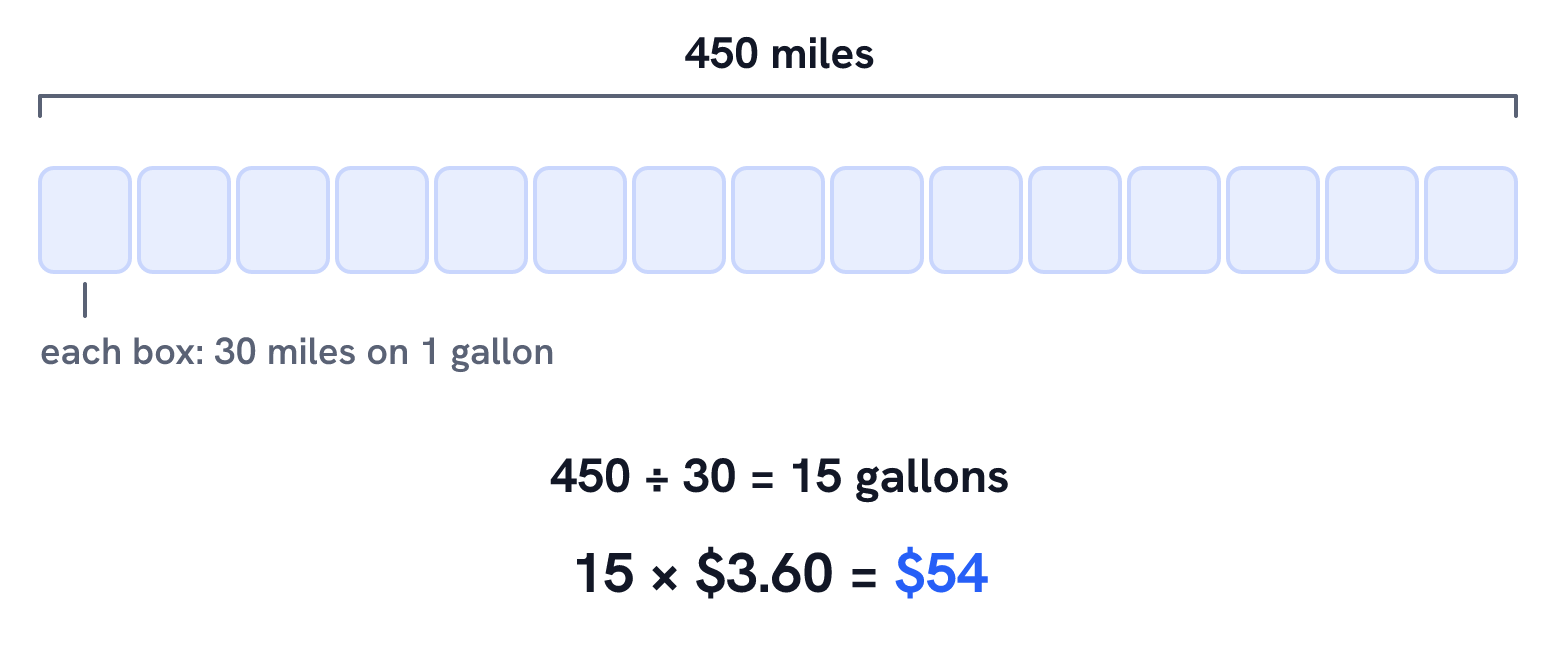
Divide the price by your mpg and you get the cost per mile: $3.60 ÷ 30 = $0.12 a mile. Multiply that by any distance for a quick estimate, so 450 miles × $0.12 = $54. A 20 mile daily commute at that rate costs $2.40 a day.
Why better mpg saves less than you'd expect#
Fuel cost falls as mpg rises, but not in a straight line. For the 450 mile trip at $3.60 a gallon:
- 20 mpg: 22.5 gallons, $81.00
- 30 mpg: 15 gallons, $54.00
- 40 mpg: 11.25 gallons, $40.50
- 50 mpg: 9 gallons, $32.40
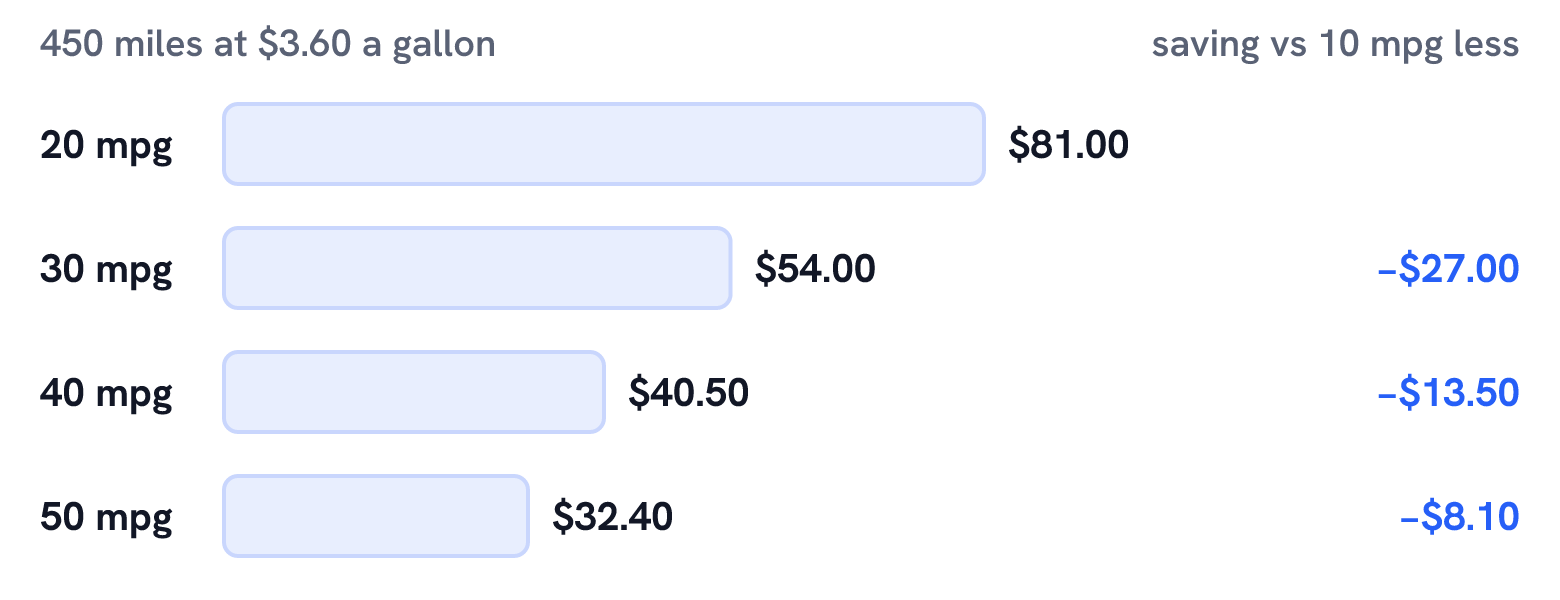
Going from 20 to 30 mpg saves $27. The next 10 mpg, from 30 to 40, saves only $13.50, and 40 to 50 saves $8.10. Gallons used depend on 1 ÷ mpg, so each extra mile per gallon matters less once a car is already efficient. The calculator shows this in its table, since it prices your trip at 5, 10, 20, 30, 40, 50 and 60 mpg alongside your own figure.
Find your car's real mpg#
The rating on a window sticker comes from standardized tests. Your own mpg, from your own driving, gives a better estimate.
- Fill the tank and reset the trip odometer.
- Drive normally until you need gas.
- Fill up again and note how many gallons it took.
- Divide the miles on the trip odometer by the gallons.
Say you drove 297 miles and the pump took 11 gallons. That's 297 ÷ 11 = 27 mpg. To find the gas for a 324 mile trip, divide again: 324 ÷ 27 = 12 gallons. Problems like this are proportions, 11/297 = x/324, and the proportion calculator solves them in one step. Mileage is also a ratio of miles to gallons, so the ratio calculator can scale 27 miles to 1 gallon up to any other distance.
Do this over a few tanks and add up the totals before dividing. Averaging the mpg from each tank gives the wrong answer unless every fill-up took the same number of gallons.
Gas cost in liters and kilometers#
Switch the calculator to metric and it takes the distance in kilometers, the price per liter and fuel use in liters per 100 km. The math flips because L/100 km measures fuel used, not distance gained.
- Liters needed = kilometers × L/100 km ÷ 100
- Trip cost = liters needed × price per liter
A 700 km trip in a car that uses 7.5 L/100 km takes 700 × 7.5 ÷ 100 = 52.5 liters. At 1.20 a liter, that's 63.00. The calculator shows a $ sign on every result, so read it as whatever currency you entered.
To convert, divide 235.21 by the mpg figure, which works in both directions: 30 mpg is 235.21 ÷ 30 = 7.84 L/100 km. That constant comes from 100 times the liters in a US gallon divided by the kilometers in a mile. With L/100 km a lower number is better, the opposite of mpg.
| Miles per Gallon | Liters per 100 Km |
|---|---|
| 15 | 15.68 |
| 20 | 11.76 |
| 25 | 9.41 |
| 30 | 7.84 |
| 35 | 6.72 |
| 40 | 5.88 |
| 50 | 4.70 |
Ways to use less gas#
The federal fuel economy site fueleconomy.gov puts numbers on the common advice. Some habits matter far more than others.
Driving style is the big one. Aggressive driving, meaning speeding, rapid acceleration and braking, can lower gas mileage by roughly 15% to 30% at highway speeds and 10% to 40% in stop-and-go traffic. On the 450 mile trip, a 15% drop takes the car from 30 mpg to 25.5 and the cost from $54 to about $63.53. Speed matters too, since gas mileage usually decreases rapidly above 50 mph.
Weight and idling add up slowly. An extra 100 pounds in the car could cut mpg by about 1%, and idling can use a quarter to a half gallon of fuel an hour.
Tire pressure is the easy one. It's worth taking a minute before a long drive to keep tires inflated to the right pressure. Use the figure on the sticker in the driver's side door jamb or glove box, or in the owner's manual, not the maximum printed on the tire's sidewall. Fueleconomy.gov puts the gain at 0.6% on average and up to 3% in some cases, and says under-inflated tires lower gas mileage by about 0.2% for every 1 psi drop in the average pressure of all tires. On a $54 trip, 0.6% is about 32 cents. Properly inflated tires are also safer and last longer.
Cost of a fill-up at different prices#
Each cell is the number of gallons times the price per gallon. For a price change, such as gas going up 3%, the percentage calculator gives the new price before you multiply.
| Gallons | $3.00 a Gallon | $3.50 a Gallon | $4.00 a Gallon | $4.50 a Gallon |
|---|---|---|---|---|
| 5 | $15.00 | $17.50 | $20.00 | $22.50 |
| 10 | $30.00 | $35.00 | $40.00 | $45.00 |
| 12 | $36.00 | $42.00 | $48.00 | $54.00 |
| 15 | $45.00 | $52.50 | $60.00 | $67.50 |
| 16 | $48.00 | $56.00 | $64.00 | $72.00 |
| 20 | $60.00 | $70.00 | $80.00 | $90.00 |
| 25 | $75.00 | $87.50 | $100.00 | $112.50 |
Sources#
- fueleconomy.gov, Gas Mileage Tips: Keeping Your Vehicle in Shape (tire pressure)
- fueleconomy.gov, Gas Mileage Tips: Driving More Efficiently (speed, aggressive driving, weight, idling)
Frequently asked questions#
How do I calculate gas cost per mile?#
Divide the price of a gallon by your mpg. At $3.60 a gallon and 30 mpg, each mile costs $3.60 ÷ 30 = $0.12. For a car that gets 20 mpg, the same gas costs $0.18 a mile.
How do I split gas money on a road trip?#
Work out the total fuel cost, then divide by the number of people sharing it. A 900 mile round trip at 30 mpg and $3.60 a gallon costs $108, which is $36 each for three people.
How many gallons of gas will I need for my trip?#
Divide the miles by your car's mpg. A 450 mile trip at 30 mpg needs 15 gallons. If your tank holds 12 gallons, plan at least one stop for gas.
How do I convert mpg to L/100 km?#
Divide 235.21 by the mpg. 25 mpg is 9.41 L/100 km, and 40 mpg is 5.88 L/100 km. The same division turns L/100 km back into mpg.
Does driving faster use more gas?#
Yes, past a point. Fueleconomy.gov says gas mileage usually decreases rapidly at speeds above 50 mph, and that aggressive driving can lower mileage by roughly 15% to 30% at highway speeds.
Why is my trip cost higher than the estimate?#
The estimate uses one mpg and one price for the whole trip. City traffic, hills, a loaded car and higher prices along the route all push the real cost up. Using the mpg you measured at the pump, not the sticker figure, brings the estimate closer.
Related calculators
View all calculators Roofing CalculatorRoofing calculator: get roof area, roofing squares, shingle bundles and felt rolls from your house footprint, eaves and roof pitch, with worked examples.
 International Shoe Size Calculator - US, UK, EU, CN & cmFree shoe size conversion calculator for US, UK, EU and cm across 450+ brands, for men and women, with a China, Japan and Australia conversion chart.
 Work Hours CalculatorWork hours calculator: total a weekly timesheet with start and end times and unpaid breaks, with hours split into regular and overtime and decimal hours.
 Circle CalculatorCircle calculator: enter the radius, diameter, circumference or area to get the other three, shown as a multiple of π and a decimal, with worked examples.
 Cubic Yards CalculatorCubic yards calculator for mulch, soil, gravel and concrete: enter the size and depth of a rectangle, circle, ring or triangle to get cubic yards and feet.
 Cylinder Volume CalculatorCylinder volume calculator: get the volume, surface areas and missing radius or height from two known values. Learn V = πr²h with tank and gallon examples.