

Work Hours Calculator
Work hours calculator: total a weekly timesheet with start and end times and unpaid breaks, with hours split into regular and overtime and decimal hours.

Written by
Alize Mendez
Updated
Monday
Tuesday
Wednesday
Thursday
Friday
Saturday
Sunday
There was an error with your calculation.
| TIME CARD | |||||
|---|---|---|---|---|---|
| Day | Start time | End time | Break | Total | Total decimal |
| Monday | 08:30 AM | 05:30 PM | 01:00 | 08:00 | 8.00 |
| Tuesday | 08:30 AM | 06:30 PM | 01:00 | 09:00 | 9.00 |
| Wednesday | 09:30 AM | 06:30 PM | 01:00 | 08:00 | 8.00 |
| Thursday | 09:00 AM | 06:00 PM | 01:00 | 08:00 | 8.00 |
| Friday | 09:00 AM | 05:30 PM | 01:00 | 07:30 | 7.50 |
| Saturday | 09:30 AM | 12:30 PM | 00:30 | 02:30 | 2.50 |
| Sunday | - | - | - | - | - |
| REG | 40:00 | 40.00 | |
|---|---|---|---|
| OT | 03:00 | 3.00 | |
| TOTAL | 43:00 | 43.00 |
Work hours calculator at a glance#
How do you calculate hours worked in a week?#
To determine the hours worked each day, you need to subtract the start time from the end time and then deduct any unpaid breaks. Once you have this information for each day, you can add them up to find the total hours for the week. The calculator above works as a weekly time card, allowing you to input a start time, an end time, and break minutes for each day from Monday through Sunday. It then calculates the weekly total in both hours and minutes, as well as in decimal hours.
How many hours is 8 to 5 with a 30 minute break?#
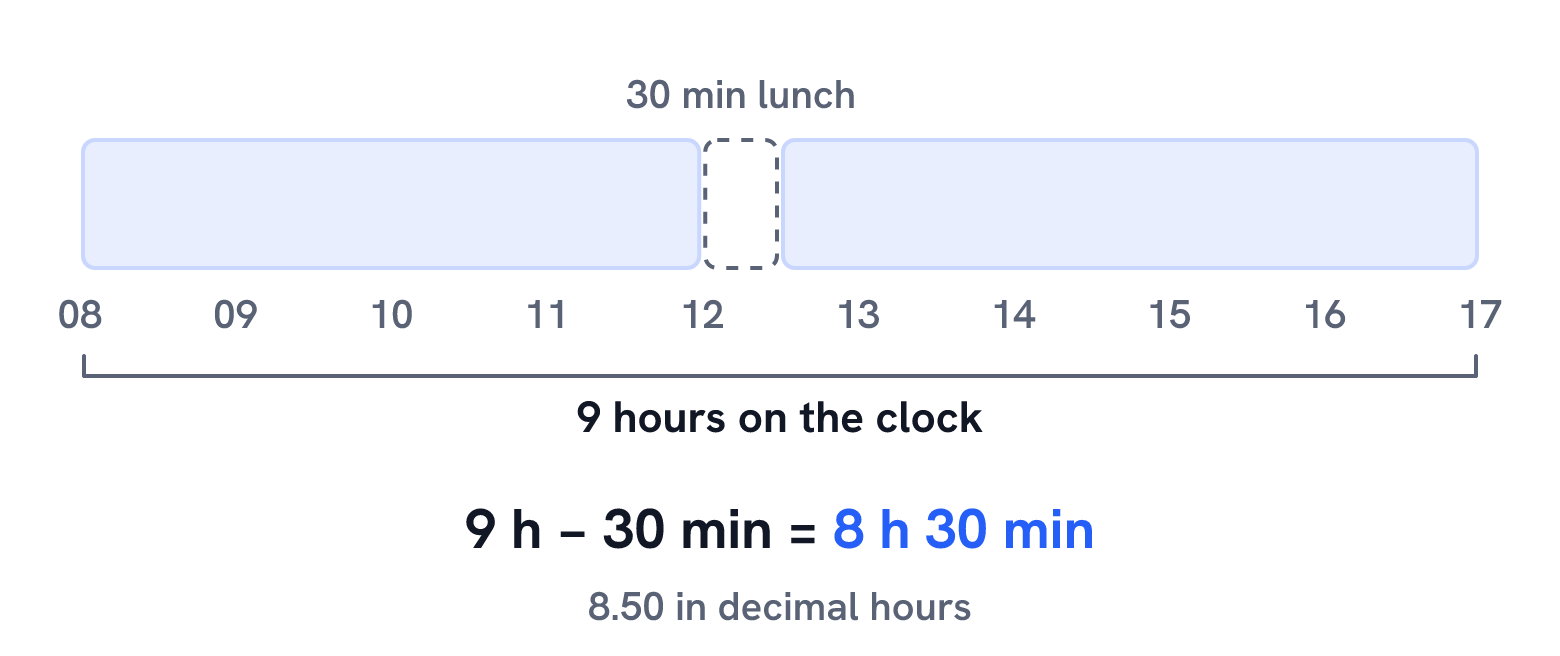
From 8:00 am to 5:00 pm, the clock shows 9 hours. After deducting a 30-minute unpaid break, the workday comes to 8 hours 30 minutes, or 8.5 hours in decimal form. Over five days, this gives 42.5 hours in a week, with 40 regular hours and 2.5 hours of overtime.
When does overtime start?#
Under the FLSA, covered employees who are not exempt must get overtime for hours over 40 in a workweek, at no less than one and a half times their regular rate. The calculator divides each week at that threshold, displaying regular hours up to 40 and any overtime beyond that point.
How the work hours calculator works#
The time card provides a row for each day of the week, and each row requires three inputs:
- Start and end times are needed in 24-hour hh:mm format. For example, 8:00 am is 08:00, and 5:00 pm is 17:00.
- The break time is recorded in minutes. Enter the unpaid break time, such as 30 for a half-hour lunch.
- Leave the row blank if no work was done, or use the clear button at the row's end.
Upon clicking Calculate, the results display each day's start, end, and break times, along with the worked hours in hh:mm format and as a decimal. Below the daily entries, the REG line shows regular hours up to 40 and the OT line shows hours over 40, with TOTAL representing the entire week.
Worked example: a week of 8 to 5 with a 30-minute lunch#
Consider a week where you work five days, Monday through Friday, from 08:00 to 17:00 each day, with a 30-minute unpaid lunch break.
Start with one day. From 08:00 to 17:00 equals 9 hours. Subtract the 30-minute break, resulting in 8 hours 30 minutes for the day. In decimal form, 30 minutes is half an hour, making the day 8.50 hours.
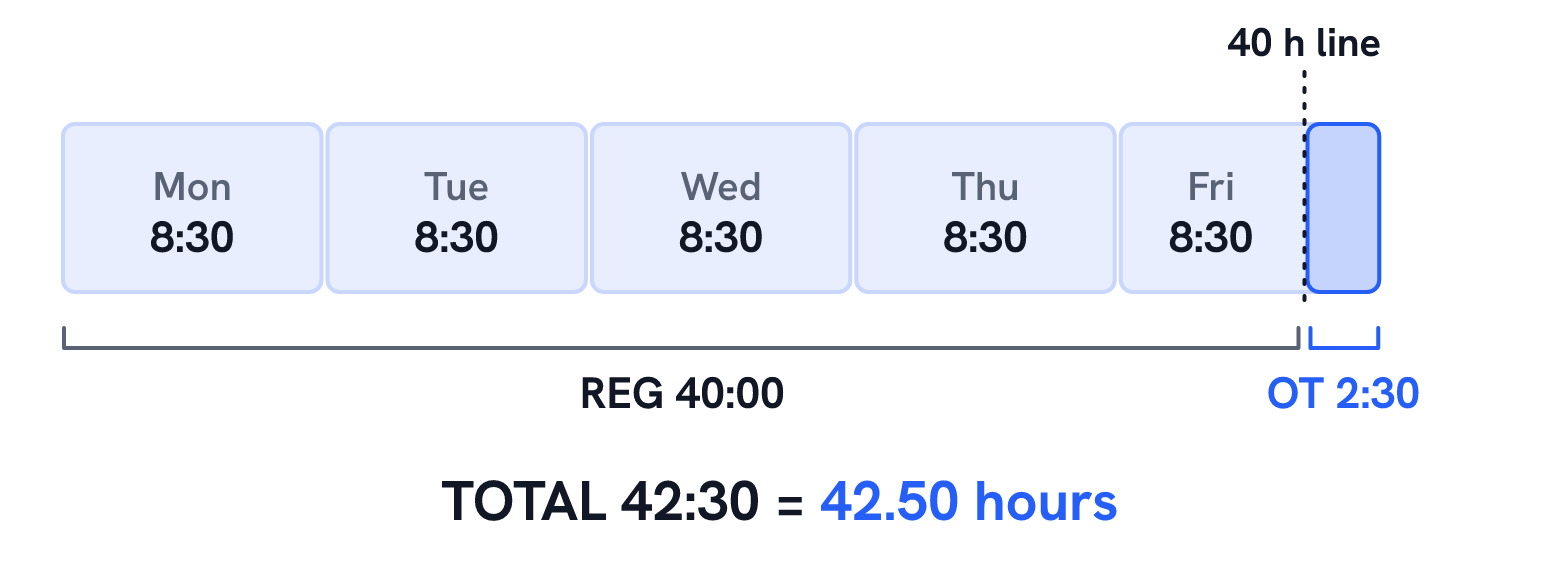
Now for the week. Five days at 8 hours 30 minutes each total 42 hours 30 minutes, or 42.50 hours in total. The initial 40 hours are regular time, while the remaining 2 hours 30 minutes (or 2.50 hours) count as overtime. The calculator displays REG 40:00 and 40.00, OT 02:30 and 2.50, and TOTAL 42:30 and 42.50.
Breaks: paid or unpaid#
For breaks, enter only the unpaid time. Federal rules state that short rest breaks, usually 20 minutes or less, count as work hours, so keep those in. Meal periods, typically 30 minutes or more, generally don't count as work time if you are completely relieved from duties. If you're required to stay at your desk and respond to calls while eating, that time counts as work.
State laws and employer policies may have different rules, and some may pay for lunch. Follow the rules that pertain to you and enter 0 in the break box on any day with no unpaid break.
Overtime: the 40-hour line#
Federal overtime rules treat each workweek as a separate entity. A workweek is a fixed, recurring period of 168 hours or seven consecutive 24-hour days. It doesn't need to start on a Monday. Hours can't be averaged over multiple weeks, so a 50-hour week followed by a 30-hour week still has 10 hours of overtime for the first week.
The calculator uses a 40-hour weekly line. It doesn't account for daily overtime, which some state laws and contracts require, and this line cannot be altered. Check your results against your own rules if they vary.
From hours to pay#
The calculator computes hours but not pay. To calculate pay, multiply the regular hours by your hourly rate and overtime hours by one and a half times that rate. At $20 an hour, the sample week amounts to 40 times $20, equaling $800, plus 2.5 times $30, which equals $75, totaling $875 before taxes. This serves as an estimate, not financial advice.
To turn an hourly rate into weekly, monthly or yearly pay, use the salary calculator.
Decimal hours and rounding#
Payroll uses decimal hours for ease of multiplication. Minutes convert to fractions of an hour: 15 minutes equals 0.25, 30 minutes equals 0.50, and 45 minutes equals 0.75. The calculator reflects both daily and weekly totals in these forms.
Many time clocks round punch times. The Labor Department accepts rounding to the nearest 5 minutes, tenth or quarter hour, as long as over time employees are paid for all time actually worked, as the time to decimal calculator page explains. Enter the times as recorded, whether rounded or not, and the calculator will total them accordingly.
Night shifts#
Each time card row holds one shift. When the end time is earlier than the start time, the calculator counts the shift as crossing midnight, so 22:00 to 06:00 with a 30-minute break comes to 7.5 hours.
The hours calculator works out the length of an overnight shift from its clock times.
Where a work hours calculator helps#
- Completing or verifying a weekly timesheet before submission to payroll.
- Checking how close you are to overtime before the final shift of the week.
- Summing up hours for freelance or contract work billed hourly.
- Comparing schedules of four 10-hour days to five 8-hour days, both of which total 40 hours.
Weekly totals for common schedules#
Each row multiplies the hours worked per day by the days worked, then splits the week at 40 hours. Hours and minutes come first, decimal hours in parentheses.
| Hours per Day | Days | Week Total | Regular | Overtime |
|---|---|---|---|---|
| 6:30 (6.50) | 5 | 32:30 (32.50) | 32.50 | 0.00 |
| 7:00 (7.00) | 5 | 35:00 (35.00) | 35.00 | 0.00 |
| 7:30 (7.50) | 5 | 37:30 (37.50) | 37.50 | 0.00 |
| 7:42 (7.70) | 5 | 38:30 (38.50) | 38.50 | 0.00 |
| 8:00 (8.00) | 5 | 40:00 (40.00) | 40.00 | 0.00 |
| 10:00 (10.00) | 4 | 40:00 (40.00) | 40.00 | 0.00 |
| 8:30 (8.50) | 5 | 42:30 (42.50) | 40.00 | 2.50 |
| 9:00 (9.00) | 5 | 45:00 (45.00) | 40.00 | 5.00 |
| 8:00 (8.00) | 6 | 48:00 (48.00) | 40.00 | 8.00 |
| 10:00 (10.00) | 5 | 50:00 (50.00) | 40.00 | 10.00 |
Sources#
- U.S. Department of Labor, Fact Sheet #23: Overtime Pay Requirements of the FLSA
- U.S. Department of Labor, Fact Sheet #22: Hours Worked Under the FLSA
- 29 CFR 785.48, Use of time clocks (rounding), Cornell Legal Information Institute
Frequently asked questions#
How many hours is 7.5 hours a day for 5 days?#
Working 7.5 hours a day for 5 days is 37.5 hours, or 37 hours 30 minutes. This is under 40, meaning all the time is regular.
How do I enter a lunch break?#
Input the unpaid minutes in the Break box for the day, such as 30 or 60. The calculator deducts these from the start and end time span. Short paid breaks are not entered.
Can I change the overtime threshold?#
No, the calculator always sets the overtime threshold at 40 hours, the federal weekly standard. For different thresholds, use the TOTAL figure and subtract your limit.
What do REG and OT mean on the time card?#
REG represents regular time, the hours up to 40 in a week. OT stands for overtime, hours exceeding 40. TOTAL combines the two.
How do I calculate my pay from my hours?#
Multiply regular decimal hours by your hourly rate and overtime decimal hours by one and a half times that rate, then sum them. 40 regular hours and 2.5 overtime hours at $20 per hour total $875 before taxes.
Related calculators
View all calculators Grade CalculatorGrade calculator: find your weighted grade from scores and category weights, and the score you need on your final exam to reach the grade you want.
 Meters to Feet ConverterMeters to feet converter: turn meters into decimal feet and into feet and inches, rounded to the inch fraction you choose. 1 m = 3.28084 ft.
 Numbers to Words ConverterFree numbers to words converter. Spell out any positive number, large amount, decimal, or check amount, with a grouping method and worked examples.
 Roman Numeral ConverterRoman numeral converter: turn any whole number from 1 to 3,999,999 into Roman numerals or a Roman numeral into a number, with bar notation above 3,999.
 Roofing CalculatorRoofing calculator: get roof area, roofing squares, shingle bundles and felt rolls from your house footprint, eaves and roof pitch, with worked examples.
 International Shoe Size Calculator - US, UK, EU, CN & cmFree shoe size conversion calculator for US, UK, EU and cm across 450+ brands, for men and women, with a China, Japan and Australia conversion chart.