How to measure overalls
Every point, drawn on the garment so there is no guessing where the tape goes.
Quick answer
Lay the overalls flat and measure eleven points: waist, inseam, hip, rise, length A, length B, thigh, knee, hem, strap and width, in fit-impact order. Waist leads, but bib length and straps decide the fit on a one-piece. Tap each step on the diagram to see where the tape sits. Sizely turns the numbers into a chart buyers trust.
Overalls are a bib one-piece, so fit hangs on more than the waist. A buyer checks the waist, then the total length and strap drop to judge whether the bib sits right and the legs reach. There are eleven points to record, and the two length runs plus the straps are the ones generic guides leave out. This page draws every one on the actual garment.

- A
Waist
Across the waist seam where the bib meets the trouser, edge to edge with the garment flat. Tap this step for the line. On a loose overall the waist is roomier than a fitted trouser, so read it where the side seams sit.Double it for the full waist circumference.
- B
Inseam
Down the inner leg seam from the crotch point to the bottom hem. Tap the step to see the run. Inseam sets the leg length, separate from the bib, so a buyer knows where the cuff lands.Recorded as-is. Do not double.
- C
Hip
Across the widest part of the seat with the overalls flat. This sets how roomy they sit through the seat before the legs begin.Double it for the full hip circumference.
- D
Rise
From the crotch seam up to the waist seam. On overalls the rise feeds into the bib above it, so it tells a buyer where the trouser portion ends.Recorded as-is. Do not double.
- E
Length A
The first length run, the total drop from the top of the bib down the front to the hem. Tap the step to see exactly where it starts and stops. This is the number that tells a buyer if the bib sits high and the legs reach.Recorded as-is. Do not double.
- F
Length B
The second length run, the bib panel or upper section measured on its own. Carried separately so the bib height is not buried inside the total length.Recorded as-is. Do not double.
- G
Thigh
Across the leg at its widest, just under the crotch, with the fabric flat. This separates a slim overall leg from a relaxed workwear cut.Double it for the full thigh circumference.
- H
Knee
Across the leg at the knee. It shows how the leg tapers from the thigh down toward the hem.Double it for the full knee circumference.
- I
Hem
Across the leg opening at the bottom. A wide hem reads loose and cuffable; a narrow hem tapers close to the ankle.Double it for the full leg opening.
- J
Strap
Along one shoulder strap, fully extended, from the bib attachment to the buckle end. Tap the step to see the run. Strap length sets how high the bib rides and is the first thing a tall or short buyer adjusts.Recorded as-is. Do not double.
- K
Width
Across the bib panel at its widest, edge to edge with the garment flat. This tells a buyer how much chest the bib covers before the straps take over.A flat panel run, recorded as-is. Do not double.
Put exact measurements on every listing, whether you sell on eBay, Shopify, or your own store.
Create your free size chart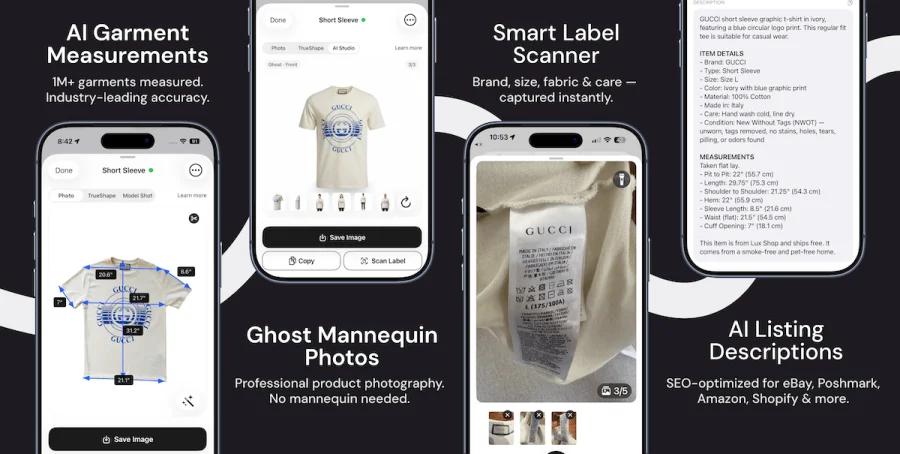
Every garment measured in 0.92 seconds, with pro photos, labels, and descriptions, from your iPhone.

Measure flat and never stretched, and treat the bib and legs as one continuous garment. Lay the overalls open and flat, with the straps unbuckled and extended for their own measurement. The across points, waist, hip, thigh, knee and hem, double to a body circumference; rise, the two length runs, the inseam and the strap are single runs recorded as measured. Width is the bib panel taken across, so it doubles only if you want a full loop.
Overalls size reference
| Size | Waist | Inseam | Hip | Rise | Strap |
|---|---|---|---|---|---|
| XS | 14 | 28 | 18 | 11 | 21 |
| S | 15 | 28.5 | 19 | 11.5 | 22 |
| M | 16.5 | 29 | 20.5 | 12 | 23 |
| L | 18 | 29.5 | 22 | 12.5 | 24 |
| XL | 19.5 | 30 | 23.5 | 13 | 25 |
Frequently asked
How do I measure the length of overalls?
Overalls carry two length runs. One is the total drop from the top of the bib down the front to the hem, and the other is the bib panel on its own. Measure both with the garment laid flat and open. Together they tell a buyer whether the bib sits high enough and the legs are long enough, which a single number cannot.
Should I measure overall straps stretched or relaxed?
Lay each strap out fully extended but not pulled tight, and measure from the bib attachment to the buckle end. If the straps are adjustable, list the longest setting so a buyer knows the full reach. Strap length is what tall and short buyers adjust first, so an honest figure here prevents a bib that rides too high or sags.
Do I double the waist on overalls?
For the body circumference, yes. Waist, hip, thigh, knee and hem are taken across one flat layer, so the full circumference is about double the flat number. A 16 inch flat waist is roughly a 32 inch waist. Rise, the two length runs, the inseam, the strap and the bib width are single runs, so those flat numbers are already the real ones.
What size am I in overalls?
Match a pair you already own to the listing's flat waist and total length first, then check the strap reach, since a one-piece depends on the bib sitting right. Overalls run small more often than trousers because the bib has to clear the chest. For the broader US, UK and EU view, see our pants size chart.
Should I list overalls in inches or centimeters?
Either works as long as you label the unit and keep it consistent across the listing. Sellers shipping internationally do best showing both, since a buyer in one market thinks in inches and another in centimeters. Sizely lists both on every chart so no buyer has to convert in their head.
Related size charts & tools
 Pants sizes (men & women)
 Women's international size chart
Sources: Sizely garment engine, spec #38 (Overall), eleven named measurement points. ISO 8559-1 body-measurement definitions (representative ranges only). Last verified June 2026.
Make the right size obvious.
Join 85,000+ sellers showing measurements buyers trust. Free to start, no card needed.