How to measure kids clothes
Every point, drawn on the garment so there is no guessing where the tape goes.
Quick answer
Lay the garment flat and measure seven points: chest, length, shoulders, sleeve (upper, lower and cuff) and hem, in that fit order. Chest leads, taken one inch below the armhole. Hover or tap each step on the diagram to see where the tape sits. Sizely turns those numbers into a kids size chart parents trust.
A parent buying for a growing child reads the age on the label, then checks chest and length against a top that already fits, because a size 6 in one brand runs like a size 8 in another. Length is what tells them how many months of wear they will get before a sleeve rides up. Most guides stop at chest and a number. This page maps all seven points on the actual garment, so the size you list survives a side-by-side check.

- A
Chest
The number a parent matches first against a shirt that fits, so it leads. Lay the garment flat and run the tape across the chest one inch below where the sleeve meets the body. Tap this step to see the exact line and where it starts.Double it for the full chest circumference.
- B
Length
A single vertical run from the shoulder seam down to the hem, following the garment and not any print on the front. This is the measurement that tracks loosely with age and tells a parent how long the piece keeps fitting.Recorded as-is. Do not double.
- C
Shoulders
Across the back from one shoulder seam to the other. It sets how wide the garment sits across a child's frame before the sleeves take over.Recorded as-is. Do not double.
- D
Sleeve A
The upper sleeve run, from the shoulder seam toward the elbow. Carrying the sleeve in two parts stops a long, active arm from being lost inside one rounded total.Recorded as-is. Do not double.
- E
Sleeve B
The lower sleeve run, from where the upper sleeve ends down to the cuff. This is where a growing kid runs out of sleeve first, so it is worth its own number.Recorded as-is. Do not double.
- F
Cuff
Across the end of the sleeve, the opening the hand passes through. A snug ribbed cuff keeps a sweatshirt sleeve from sliding down, so it matters more than its small size suggests.Double it for the cuff circumference.
- G
Hem
Across the bottom opening of the garment. A wider hem reads relaxed and layers over other clothes; a banded hem pulls in. Many guides skip it, but it changes how the piece wears.Double it for the full hem circumference.
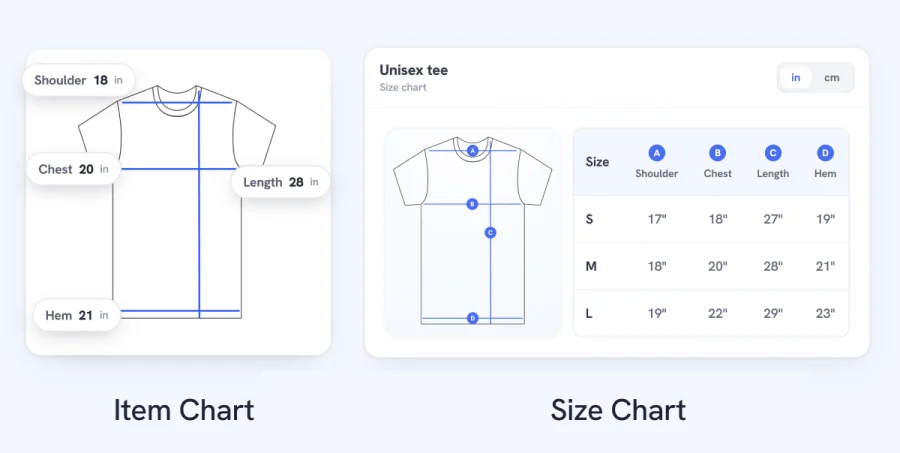
Put exact measurements on every listing, whether you sell on eBay, Shopify, or your own store.
Create your free size chart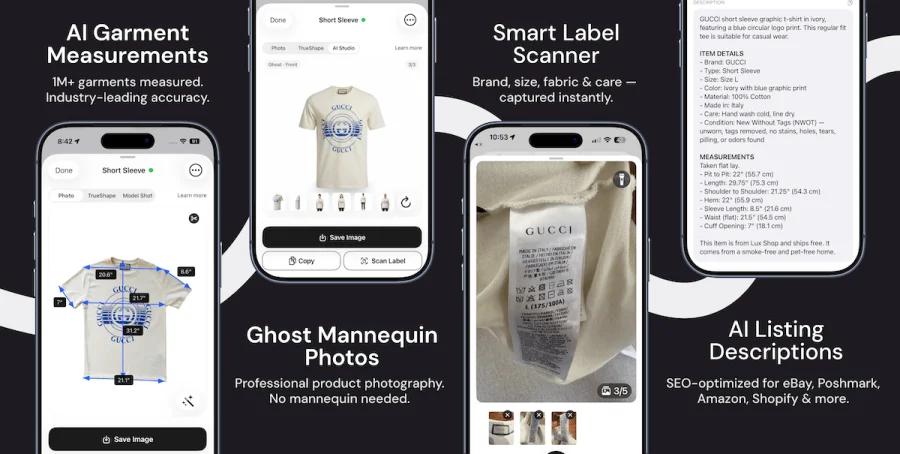
Every garment measured in 0.92 seconds, with pro photos, labels, and descriptions, from your iPhone.

Measure flat and never stretched, especially on a fleece or ribbed cuff that lengthens the second you pull it. Read length as a rough age guide rather than a guarantee, since kids the same age vary a lot. Three of these, chest, cuff and hem, are across measurements that double to a body circumference; length, shoulders and the two sleeve runs are single passes you record exactly as they read.
Kids clothes size reference
| Size | Chest | Length | Shoulders | Sleeve | Cuff |
|---|---|---|---|---|---|
| 2-3Y | 11.5 | 15 | 9 | 9.5 | 2.6 |
| 4-5Y | 12.5 | 17 | 10 | 11 | 2.8 |
| 6-7Y | 13.5 | 19 | 11 | 12.5 | 3 |
| 8-9Y | 15 | 21 | 12 | 14 | 3.2 |
| 10-12Y | 16.5 | 23 | 13 | 16 | 3.4 |
Frequently asked
How do I measure kids' clothes that already fit my child?
Pick a top your child wears comfortably right now and lay it flat. Take the chest straight across one inch below the armhole, the length from the shoulder seam to the hem, and the sleeve from shoulder to cuff. Those three numbers tell you more than any age label, since you can match them against a seller's measured chart instead of guessing on size.
Which kids' clothing measurements double and which do not?
Chest, cuff and hem are across measurements taken over one flat layer, so the body circumference is roughly double the flat number. Length, shoulders and the two sleeve runs are single passes down the garment, so the flat number is already the real number. When a chart looks small, that is usually because it lists the flat chest, not the doubled body figure.
What size kids' clothes should I buy if my child is between sizes?
Size up. Kids grow fast, and a slightly roomy top is worn for months while a snug one is outgrown in weeks. Use chest as the deciding number, then check that the length is not so long it swamps them now. If the brand runs small, which many do, the next size up is the safer buy.
Why do kids' sizes vary so much between brands?
Because the age or year on the label is not a regulated measurement, each brand cuts its own way, so a size 6 can differ by inches between two labels. That is exactly why a measured chart beats an age tag. List the real chest, length and sleeve, and a parent can buy with confidence no matter how your sizing compares to another brand.
How do kids' sizes convert between US, UK and EU?
Children's sizing is labelled by age or height in most regions, but the cut-off ages and number runs differ, so a US size does not map one to one onto a UK or EU one. For the full breakdown, see our children's international size chart, and for older children and teens the youth size chart carries the larger end of the range.
Related size charts & tools
 Youth size chart
 Children's international size chart
Sources: Sizely garment engine, spec #275 (Kids Sweatshirt), seven named measurement points. EN 13402 body-dimension labelling for children's clothing (representative ranges only). Last verified June 2026.
Make the right size obvious.
Join 85,000+ sellers showing measurements buyers trust. Free to start, no card needed.