How to measure a vest
Every point, drawn on the garment so there is no guessing where the tape goes.
Quick answer
Lay the vest flat and take six points in fit order: chest, length, shoulder, armhole (sleeve A), waist and hem. A vest has no sleeves, so chest and the chest-to-waist shaping carry the fit. Hover or tap each step on the diagram for the exact line. Sizely turns those numbers into a chart buyers trust.
Because a vest is sleeveless, a buyer judges fit almost entirely on chest and how the waist nips in beneath it. That makes the armhole the quiet third factor, since it decides whether the vest sits clean over a shirt or gaps at the arm. Plenty of guides treat a vest like a shrunken jacket; this one maps the six points that actually decide a vest's fit.

- A
Chest
Button the vest, lay it flat, and measure straight across one inch below the armhole seams. Tap this step on the diagram to confirm the line. On a sleeveless garment chest does most of the fitting work, so it leads the chart.Double it for the full chest circumference.
- B
Length
A single run from the top of the shoulder down to the front point or hem. Tap the step to see where the line starts and ends. Length decides whether the vest covers the waistband or stops short above it.Recorded as-is. Do not double.
- C
Shoulder
Across the back from one shoulder seam to the other, over the narrow strap a vest leaves at the top. This sets how far the vest reaches toward the shoulder before the armhole opens.Recorded as-is. Do not double.
- D
Sleeve A
On a vest this is the armhole run, measured down the curved opening from the shoulder seam to the underarm rather than along a sleeve. Tap the step to see the edge it follows. It governs how the vest clears the arm and whether the shirt shows through.Recorded as-is. Do not double.
- E
Waist
Across the narrowest point of the side seam. The drop from chest to waist is what shapes a vest, so this number tells a buyer whether it cuts in close or hangs straight.Double it for the full waist circumference.
- F
Hem
Across the bottom opening, point to point at the front edges. A wider hem reads relaxed; a narrow one finishes the tapered, fitted look.Double it for the full hem circumference.
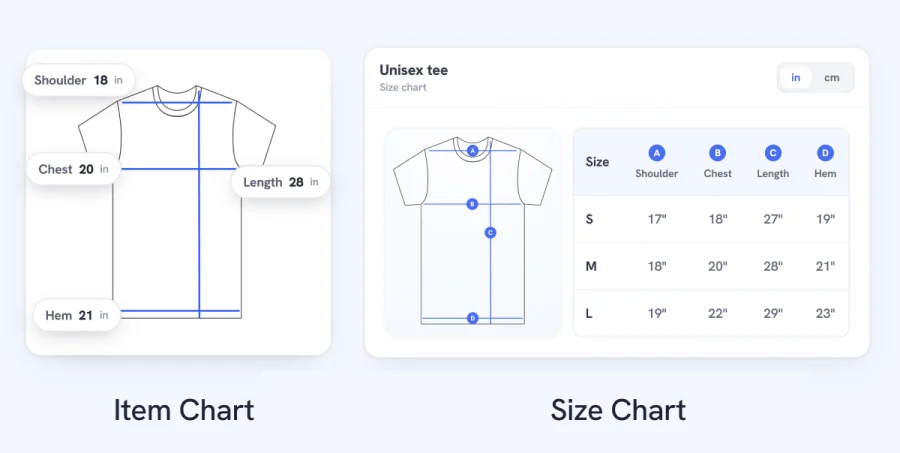
Put exact measurements on every listing, whether you sell on eBay, Shopify, or your own store.
Create your free size chart
Every garment measured in 0.92 seconds, with pro photos, labels, and descriptions, from your iPhone.

Measure flat and never stretched, buttoned up and pressed smooth so the front panels meet evenly. With no sleeves to distract you, the chest-to-waist taper is the whole story, so keep the tape level on both. Chest, waist and hem cross a single layer and double to a circumference; length, shoulder and the armhole run are single passes recorded exactly as they read.
Vest size reference
| Size | Chest | Length | Shoulder | Waist | Hem |
|---|---|---|---|---|---|
| S | 19 | 23 | 13.5 | 17 | 18 |
| M | 20.5 | 23.5 | 14 | 18.5 | 19.5 |
| L | 22 | 24 | 14.5 | 20 | 21 |
| XL | 23.5 | 24.5 | 15 | 21.5 | 22.5 |
| 2XL | 25 | 25 | 15.5 | 23 | 24 |
Frequently asked
How do I measure a vest with no sleeves?
Treat the chest and waist exactly as you would on any top, taken flat across the buttoned front, then measure the armhole as a curved run from the shoulder seam down to the underarm instead of along a sleeve. Length runs from shoulder to the hem point. With no sleeve length to record, the chest-to-waist drop and the armhole carry most of the fit.
What is the armhole measurement on a vest?
It is the length of the curved opening where a sleeve would attach, measured along the edge from the shoulder seam to the underarm point. A roomy armhole lets the vest sit comfortably over a shirt, while a tight one can pull or expose the shirt at the side. Record it as a single pass, since it is a linear run and not doubled.
Which vest measurements should I double and which stay flat?
Double the across points, chest, waist and hem, because each is taken over a single flat layer and the body figure is roughly twice the flat. Length, shoulder and the armhole run are single passes, so the flat number is already the real number. Listing both the flat and the doubled figure spares your buyer the math.
How do I know what size vest I am?
Measure your own chest circumference over the shirt you would wear, halve it, and match that to the flat chest on the chart, choosing the size at or just above it. Then check the waist drop to see whether the cut suits your shape. For a cross-reference to numbered sizing, see our men's international size chart.
Should I list vest measurements in inches or centimeters?
Either is fine, as long as you label the unit and keep every row consistent. Sellers shipping to more than one country do best showing both, since buyers read the unit they grew up with. Sizely puts inches and centimeters on every chart, so no buyer has to convert before they commit.
Related size charts & tools
 Men's international size chart
 Women's international size chart
Sources: Sizely garment engine, spec #22 (Dress Vest), six named measurement points. ISO 8559-1 garment body-measurement definitions (representative ranges only). Last verified June 2026.
Make the right size obvious.
Join 85,000+ sellers showing measurements buyers trust. Free to start, no card needed.