How to measure a t-shirt
Every point, drawn on the garment so there is no guessing where the tape goes.
Quick answer
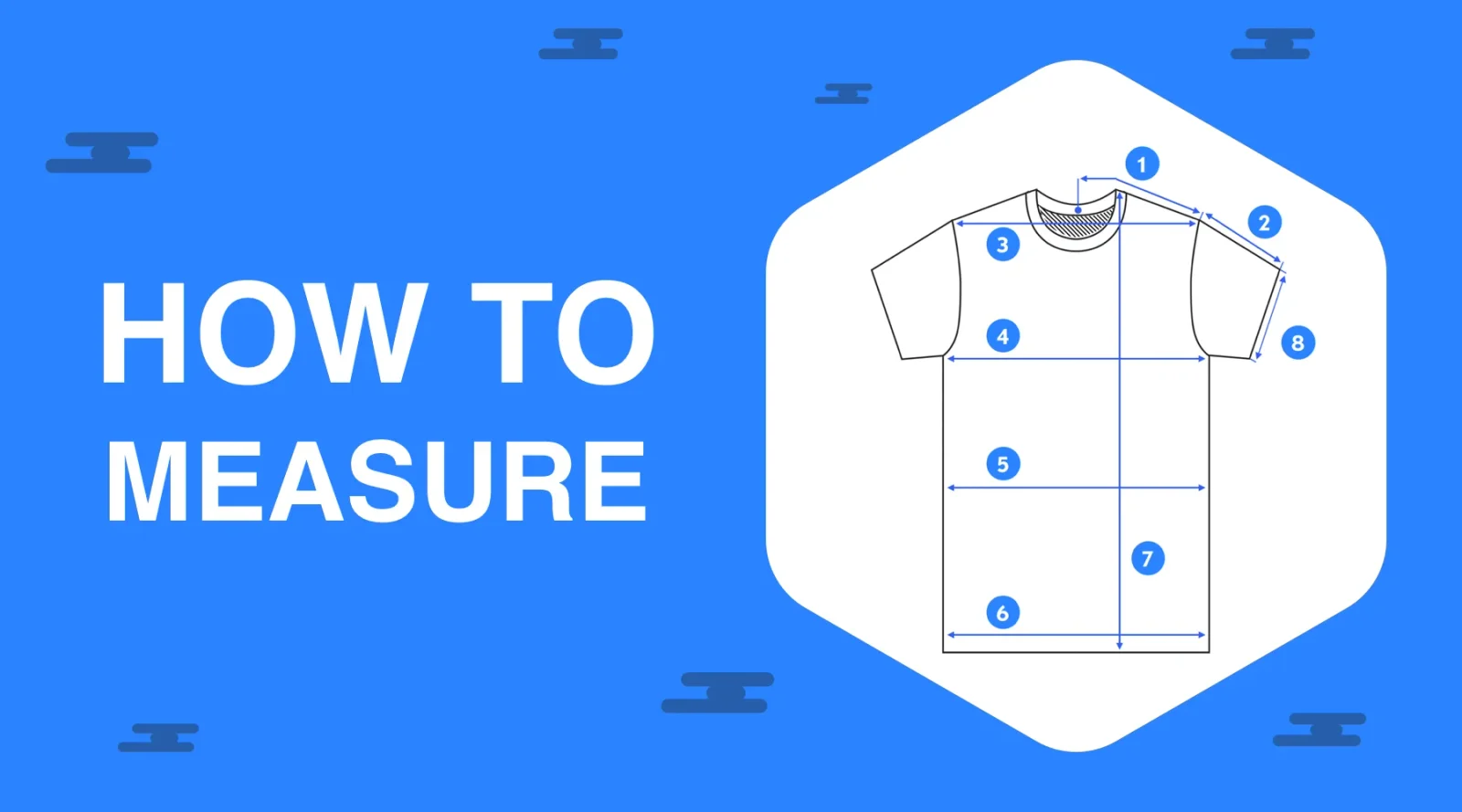
Lay the t-shirt flat and measure eight points: chest, length, shoulder, sleeve (upper, lower and cuff), waist and hem, in that order of fit-impact. Chest leads, taken one inch below the armhole, the point most guides skip. Hover or tap each step on the diagram to see exactly where the tape sits. Sizely turns those numbers into a size chart buyers trust.
A buyer comparing your listing to a shirt in their closet checks chest, length and shoulder first, and there are eight points in all. Generic guides show three or four and skip the rest. This page draws every one on the actual garment, so you measure the same points the buyer will check.

- A
Chest
The first measurement a buyer checks, so it leads. Lay the shirt flat and smooth, then take the chest across the body. Hover or tap this step to see the exact line and where it starts.Double it for the full chest circumference.
- B
Length
A single vertical run down the shirt. Tap the step to see where the line begins at the shoulder and ends at the hem, so you follow the garment and not the print.Recorded as-is. Do not double.
- C
Shoulder
Across the back, seam to seam. This sets how wide the shirt sits before the sleeves begin.Recorded as-is. Do not double.
- D
Sleeve A
The first sleeve run, from the shoulder toward the elbow. The chart carries the sleeve in parts so none is buried in a single rounded number.Recorded as-is. Do not double.
- E
Sleeve B
The second sleeve run, picking up where the upper sleeve ends. Short on a tee, longer on a long sleeve.Recorded as-is. Do not double.
- F
Cuff
The opening the arm passes through, across the end of the sleeve. Generic guides drop it, but for fitted sleeves it decides whether the arm slides through.Double it for the cuff circumference.
- G
Waist
Across the body at its narrowest point. On a boxy tee the waist and chest read close; on a fitted tee the waist pulls in.Double it for the full waist circumference.
- H
Hem
Across the bottom opening of the shirt. A wide hem reads boxy, a narrow hem tapers.Double it for the full hem circumference.
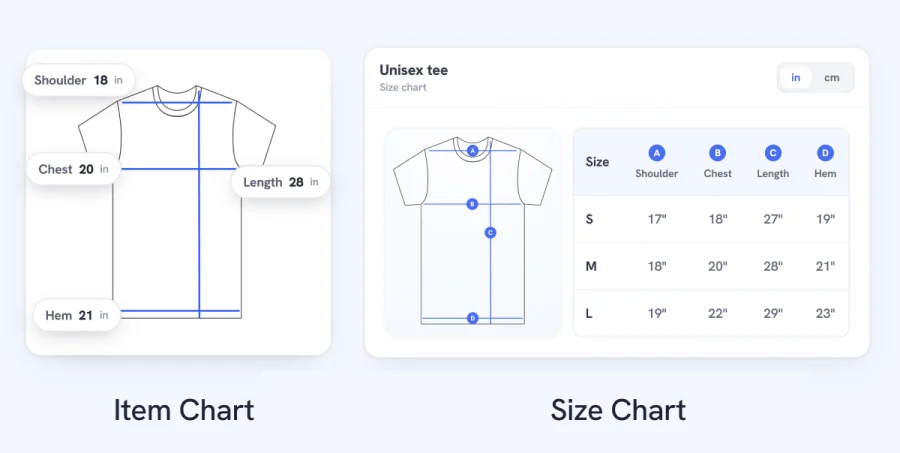
Put exact measurements on every listing, whether you sell on eBay, Shopify, or your own store.
Create your free size chart
Every garment measured in 0.92 seconds, with pro photos, labels, and descriptions, from your iPhone.

Measure flat and never stretched. Keep the tape flat against the fabric and the shirt smooth, with nothing pulled tight. A flat, edge-to-edge number is the one a buyer can verify by laying their own shirt down and checking the tape. The four across measurements, chest, waist, hem and cuff, double to a body circumference; length, shoulder and the two sleeve runs are recorded exactly as measured.
T-shirt size reference
| Size | Chest | Length | Shoulder | Sleeve | Waist |
|---|---|---|---|---|---|
| S | 19 | 28 | 17.5 | 8 | 18.5 |
| M | 21 | 29 | 18.5 | 8.5 | 20 |
| L | 23 | 30 | 19.5 | 9 | 22 |
| XL | 25 | 31 | 20.5 | 9.5 | 24 |
| 2XL | 27 | 32 | 21.5 | 10 | 26 |
Frequently asked
How do I measure a t-shirt for printing or screen printing?
Measure the same flat points, chest, length and shoulder, then set your print area from a fixed reference, usually a set distance down from the collar and centered between the shoulder seams. A common starting point for a standard front print is two to four inches below the collar, though placement varies by design and shirt size. Print on the actual garment size, since the print area scales with the shirt, not the design file.
What is the average chest measurement for a men's t-shirt?
Men's tees typically run from about 18 to 19 inches flat for a small up to 26 to 27 inches flat for a 2XL, measured pit to pit. Double the flat number for the body circumference, so a 21 inch flat chest is roughly a 42 inch chest. Brands vary, which is why your own measured chart is more reliable than a generic size guide.
What is the difference between flat and body measurements?
A flat measurement is taken across the laid-flat garment, edge to edge, on a single folded layer. A body measurement is the circumference around the person. For the across points, chest, waist, hem and cuff, the body number is roughly double the flat number. Length, shoulder and the sleeve runs are single passes, so the flat number is already the real number.
Do I need to double the chest measurement?
For the flat chart number, no, record it as measured. To estimate the body circumference, double the chest, waist, hem and cuff. Most size charts list the flat number because it is the one a buyer can verify by laying their own shirt down and checking the tape.
Should I measure a t-shirt in inches or centimeters?
Either works, as long as you stay consistent and label the unit. Sellers shipping internationally do best showing both, since a buyer in one market thinks in inches and another in centimeters. Sizely lists both on every chart so no buyer has to convert in their head.
Where exactly is the chest measured on a t-shirt?
One inch below the point where the sleeve seams meet the body, straight across from edge to edge with the shirt laid flat. Measuring higher catches the armhole and reads too wide; measuring lower drifts into the waist. Hover or tap the chest step on the diagram to see the exact line.
Related size charts & tools
 Men's international size chart
 Women's international size chart
Sources: Sizely garment engine, spec #88 (T-Shirt Male), eight named measurement points. ASTM D5585 adult body-measurement tables (representative ranges only). Last verified June 2026.
Make the right size obvious.
Join 85,000+ sellers showing measurements buyers trust. Free to start, no card needed.