How to measure a sweater
Every point, drawn on the garment so there is no guessing where the tape goes.
Quick answer
Lay the knit sweater flat, relaxed, and measure eleven points: chest, length, shoulder, sleeve (upper and lower), arm, forearm, cuff, waist, hem and hip, in fit-impact order. Knit stretches, so let it settle before you read the chest, the point most guides take pulled tight. Tap each step on the diagram to see where the tape sits.
A sweater shopper checks the chest first, then the length, because a knit drapes by how it relaxes, not by how far it can stretch. Eleven points describe that fit, including the hip width at the bottom that decides whether it skims or clings. Many listings list a chest alone. This page draws every point on the garment so a buyer reads the same relaxed numbers you take.

- A
Chest
The number a buyer reads first, taken straight across the body an inch below the armhole on the relaxed knit. Tap this step for the exact line. Pulling a sweater taut here adds phantom inches, so smooth it flat and leave it slack.Double it for the full chest circumference.
- B
Length
One vertical run from the high shoulder point down to the bottom hem. Tap the step to see where the line begins. On a knit, length can grow over wear, so measure it resting and note that heavier yarns may drop a touch.Recorded as-is. Do not double.
- C
Shoulder
Seam to seam across the back. A set-in shoulder gives a clear point to point line; a raglan or drop shoulder blurs it, so follow the actual seam where you can.Recorded as-is. Do not double.
- D
Sleeve A
The upper sleeve run, from the shoulder seam toward the elbow. Measuring the sleeve in two parts keeps a long knit sleeve from rounding away into one number.Recorded as-is. Do not double.
- E
Sleeve B
The lower sleeve run, from where the upper sleeve ends to the ribbed cuff. With Sleeve A it gives the full reach a buyer feels at the wrist.Recorded as-is. Do not double.
- F
Cuff
Across the ribbed cuff at the wrist, measured relaxed. The rib gives the most of any point on a sweater, so resist stretching it flat and read it where it settles.Double it for the cuff circumference.
- G
Waist
Across the body at its narrowest point. A straight knit reads close to the chest; a shaped or fitted sweater nips in, so the chest-to-waist gap signals the silhouette.Double it for the full waist circumference.
- H
Hem
Across the bottom ribbed band, read relaxed. This band hugs the body, so a buyer wants the resting width, not the rib pulled open.Double it for the full hem circumference.
- I
Arm
Across the widest part of the upper sleeve near the armhole. On a knit this width relaxes wider than it looks worn, so read it slack, and tap the step for the exact line.Double it for the full upper-arm circumference.
- J
Forearm
Across the lower sleeve between the elbow and the cuff. This shows how the knit sleeve tapers, something a single sleeve length cannot tell a buyer.Double it for the full forearm circumference.
- K
Hip
Across the widest part of the lower body of the sweater, below the waist, where a longer knit sits over the hips. Tap the step to see the line. This decides whether the hem skims the hips or pulls snug across them.Double it for the full hip circumference.
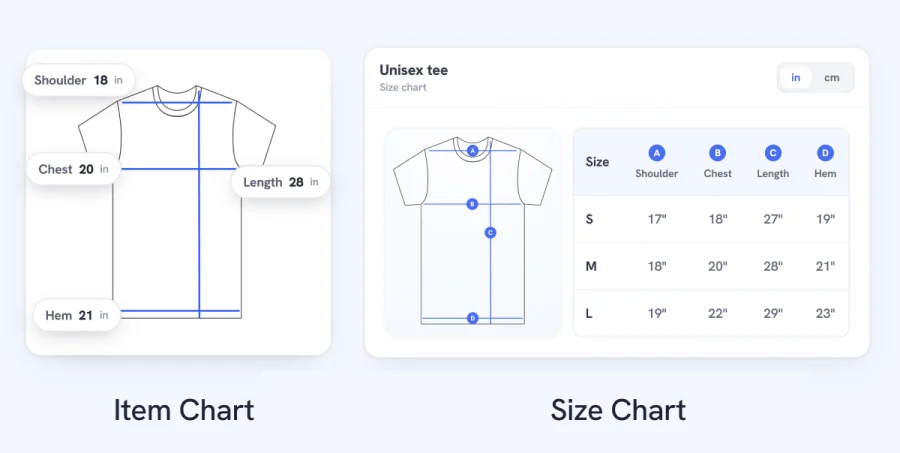
Put exact measurements on every listing, whether you sell on eBay, Shopify, or your own store.
Create your free size chart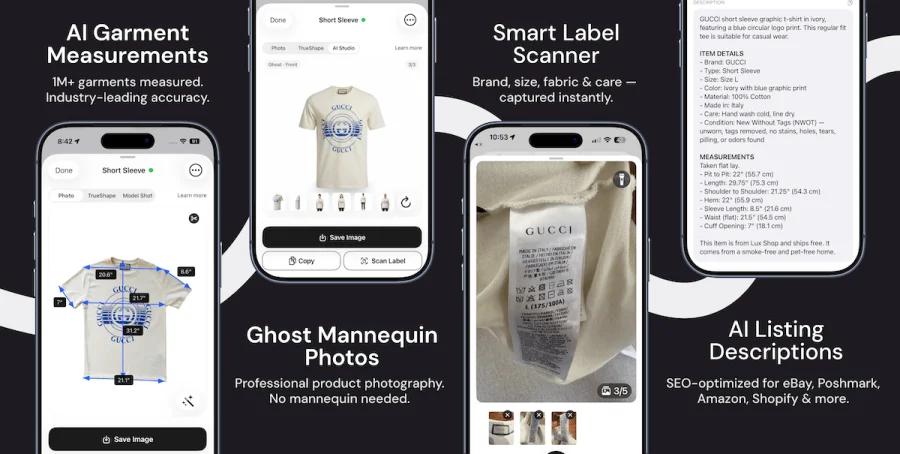
Every garment measured in 0.92 seconds, with pro photos, labels, and descriptions, from your iPhone.

Measure flat and relaxed, never stretched, and this matters most on a knit because the yarn gives several inches under tension. The across points, chest, arm, forearm, cuff, waist, hem and hip, each double to a body circumference; length, shoulder and the two sleeve runs stay as single passes. Let the rib settle and record the resting number a buyer can match.
Sweater size reference
| Size | Chest | Length | Shoulder | Sleeve | Waist |
|---|---|---|---|---|---|
| S | 20 | 25.5 | 17 | 23.5 | 19 |
| M | 22 | 26.5 | 18 | 24.5 | 21 |
| L | 24 | 27.5 | 19 | 25.5 | 23 |
| XL | 26 | 28.5 | 20 | 26 | 25 |
| 2XL | 28 | 29.5 | 21 | 26.5 | 27 |
Frequently asked
Why should I measure a knit sweater relaxed instead of stretched?
Knit yarn gives several inches under tension, so a stretched chest or waist reports a sweater far bigger than it wears, and the buyer ends up with something that hangs loose. Lay it flat, smooth it without pulling, and let the ribbed cuffs and hem settle. The relaxed reading is the honest one, and it is the only number a buyer can repeat at home.
Does a sweater stretch after I measure it?
It can. A knit relaxes with wear and body heat, then often recovers after washing, while heavier yarns may grow slightly in length over time. Measure the garment as it rests new, note the fiber if it is prone to stretching, and let the buyer factor in that knits move more than wovens. A measured chart still beats guessing from a size letter.
Which sweater measurements double and which stay the same?
Double the across points: chest, arm, forearm, cuff, waist, hem and hip, since each spans one flat layer and the body wraps both sides. Keep length, shoulder and the two sleeve runs exactly as measured, because each runs once along the garment. So a 22 inch flat chest is roughly a 44 inch body circumference.
What size sweater am I if my chest is 40 inches?
A 40 inch body chest usually lands at a medium in a standard relaxed sweater, near a 21 to 22 inch flat chest with the knit settled. Because knits stretch and brands cut them differently, check the relaxed flat chest and the hip width against a sweater you already own rather than trusting the size label alone.
Should I list sweater measurements in inches or centimeters?
Either works, as long as you stay consistent and label the unit on the chart. A seller shipping internationally does best showing both, since one buyer thinks in inches and another in centimeters. Sizely lists both on every chart. For regional sizing, see our women's international size chart.
Related size charts & tools
 Men's international size chart
 Women's international size chart
Sources: Sizely garment engine, spec #353 (Crewneck Sweater), eleven named measurement points. ISO 8559 garment-measurement reference (representative ranges only). Last verified June 2026.
Make the right size obvious.
Join 85,000+ sellers showing measurements buyers trust. Free to start, no card needed.