How to measure a parka
Every point, drawn on the garment so there is no guessing where the tape goes.
Quick answer
Lay the parka flat and record ten points in fit order: chest, waist, hip, length, shoulder, sleeve A, sleeve B, cuff, arm and forearm. Chest leads, read across a zipped front with room for bulky layers. Hover or tap each step on the diagram for the exact line. Sizely turns those numbers into a chart buyers trust.
A parka is bought for warmth, so a buyer checks chest first, then hip, because the coat has to close over heavy layers and still cover the hips against the cold. The hip number is the one most jacket guides skip, yet on a longer winter parka it decides whether the hem flares or binds. This page maps all ten points on the garment so nothing about the fit is left to chance.

- A
Chest
Zip the front, flatten the shell as much as it allows, and run the tape across one inch below the armhole seams. Tap this step on the diagram for the line. A parka is built to clear thick layers, so a roomy chest reading is expected here.Double it for the full chest circumference.
- B
Waist
Across the midsection at the narrowest point, or at the drawcord if the parka has one. The chest-to-waist relationship shows whether the parka falls straight or draws in for shape.Double it for the full waist circumference.
- C
Hip
Across the widest part lower down the body, where a longer parka sits over the hips. Tap the step to find the line. This is the point jacket guides leave out, and on a winter parka it decides whether the hem clears the hips cleanly.Double it for the full hip circumference.
- D
Length
A single run from the top of the shoulder seam straight down to the hem, past any hood seam at the neck. Tap the step for the start and end points. Length marks the difference between a hip-length parka and one that drops to the thigh.Recorded as-is. Do not double.
- E
Shoulder
Seam to seam across the back. On a heavy parka the shoulder carries the weight of the insulation, so this width sets how the whole coat hangs.Recorded as-is. Do not double.
- F
Sleeve A
The upper sleeve, taken from the shoulder seam toward the elbow. Recording the sleeve in two parts keeps an insulated arm from collapsing into one rounded number.Recorded as-is. Do not double.
- G
Sleeve B
The lower sleeve, carried from the elbow to the cuff edge. Add it to the upper run for a full sleeve that will cover the wrist over a thick jumper.Recorded as-is. Do not double.
- H
Cuff
Across the sleeve opening at the wrist, outside any inner storm cuff. A parka cuff has to pass over a glove or thick sleeve, so its width is a genuine wearability check.Double it for the full cuff circumference.
- I
Arm
Across the widest part of the upper sleeve at the bicep. On a padded parka this is what lets the arm and its layer move without straining the seam.Double it for the full bicep circumference.
- J
Forearm
Across the lower sleeve nearer the cuff. Read with the cuff number, it shows how the insulated sleeve tapers from bicep down to the wrist.Double it for the full forearm circumference.
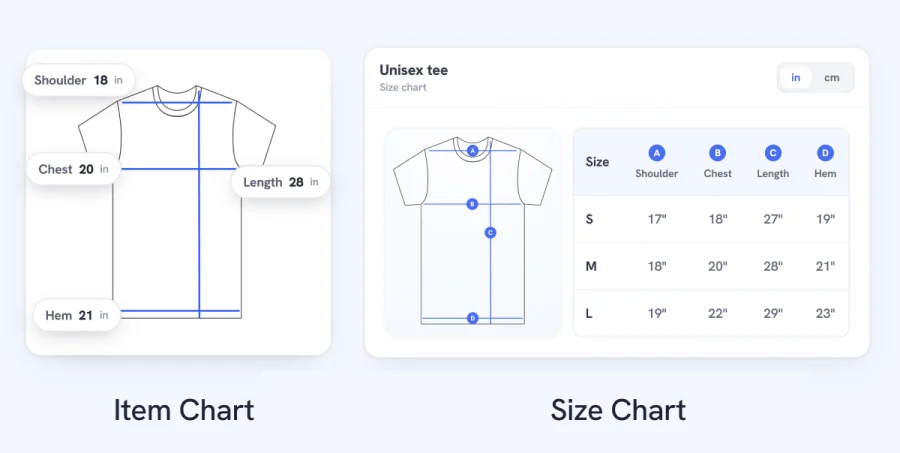
Put exact measurements on every listing, whether you sell on eBay, Shopify, or your own store.
Create your free size chart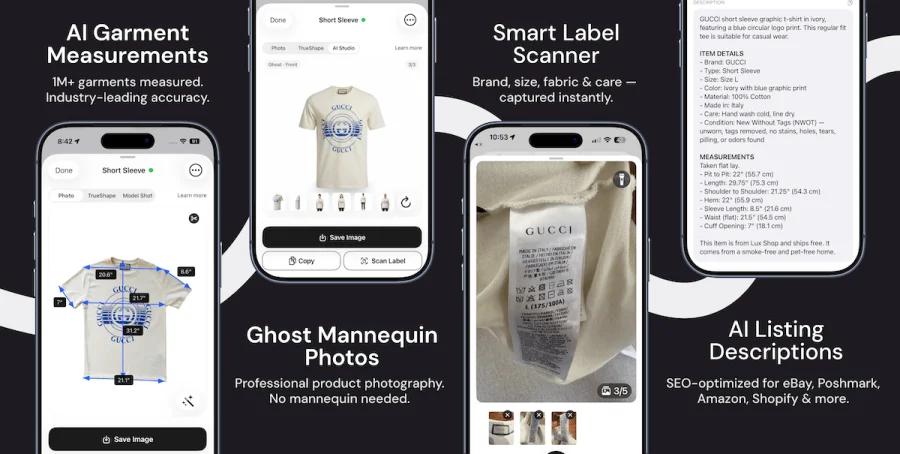
Every garment measured in 0.92 seconds, with pro photos, labels, and descriptions, from your iPhone.

Measure flat and never stretched, zipped to the top with the insulated shell pressed as flat as it will go. A puffy parka resists lying smooth, so press out the loft gently rather than crushing or tugging it. Chest, waist, hip and cuff cross one layer and double to a circumference; length, shoulder, both sleeve runs, arm and forearm are single passes recorded exactly as they read.
Parka size reference
| Size | Chest | Waist | Hip | Length | Shoulder |
|---|---|---|---|---|---|
| S | 22 | 21 | 23 | 32 | 18.5 |
| M | 24 | 23 | 25 | 33 | 19 |
| L | 26 | 25 | 27 | 34 | 19.5 |
| XL | 28 | 27 | 29 | 35 | 20 |
| 2XL | 30 | 29 | 31 | 36 | 20.5 |
Frequently asked
How do I measure a parka to fit over heavy layers?
Zip it up, lay it flat, and read the chest one inch below the armhole, then check the hip the same way lower down. The room for layers is already built into the cut, so you record the numbers as they sit rather than adding inches. Doubling the flat chest and hip gives the body circumference, so a buyer can see how a sweater and mid-layer will fit underneath.
Why does a parka have a hip measurement when a jacket does not?
A parka is usually longer than a jacket, dropping to the hip or thigh for extra warmth, so the hip is where the lower body actually fills the coat. Measuring it flat across the widest lower point, then doubling for the circumference, tells a buyer whether the hem will close over the hips or pull. On a short jacket that ends at the waist there is no hip to measure.
Which parka measurements double and which stay as measured?
Double the across points, chest, waist, hip and cuff, since each is taken over a single flat layer and the body number is roughly twice the flat. Length, shoulder, both sleeve runs, arm and forearm are single passes, so the flat figure is already the real number. Showing both the flat and the doubled value saves your buyer from doing the conversion.
Should I list parka measurements in inches or centimeters?
Either works as long as you label the unit and keep it consistent on every row. Winter buyers often shop across borders for the warmest coat, so listing inches and centimeters together removes a step. Sizely shows both units on each chart, so no buyer has to convert before deciding.
What size parka am I based on the measurements?
Measure your own chest circumference over the layers you plan to wear, halve it, and match that to the flat chest on the chart, picking the size at or just above it. Then confirm the hip is wide enough for a longer parka to clear your lower body. For a cross-check against numbered sizing, see our women's international size chart.
Related size charts & tools
 Men's international size chart
 Women's international size chart
Sources: Sizely garment engine, spec #209 (Parka), ten named measurement points. ISO 8559-1 garment body-measurement definitions (representative ranges only). Last verified June 2026.
Make the right size obvious.
Join 85,000+ sellers showing measurements buyers trust. Free to start, no card needed.