How to measure glasses
Every point, drawn on the garment so there is no guessing where the tape goes.
Quick answer
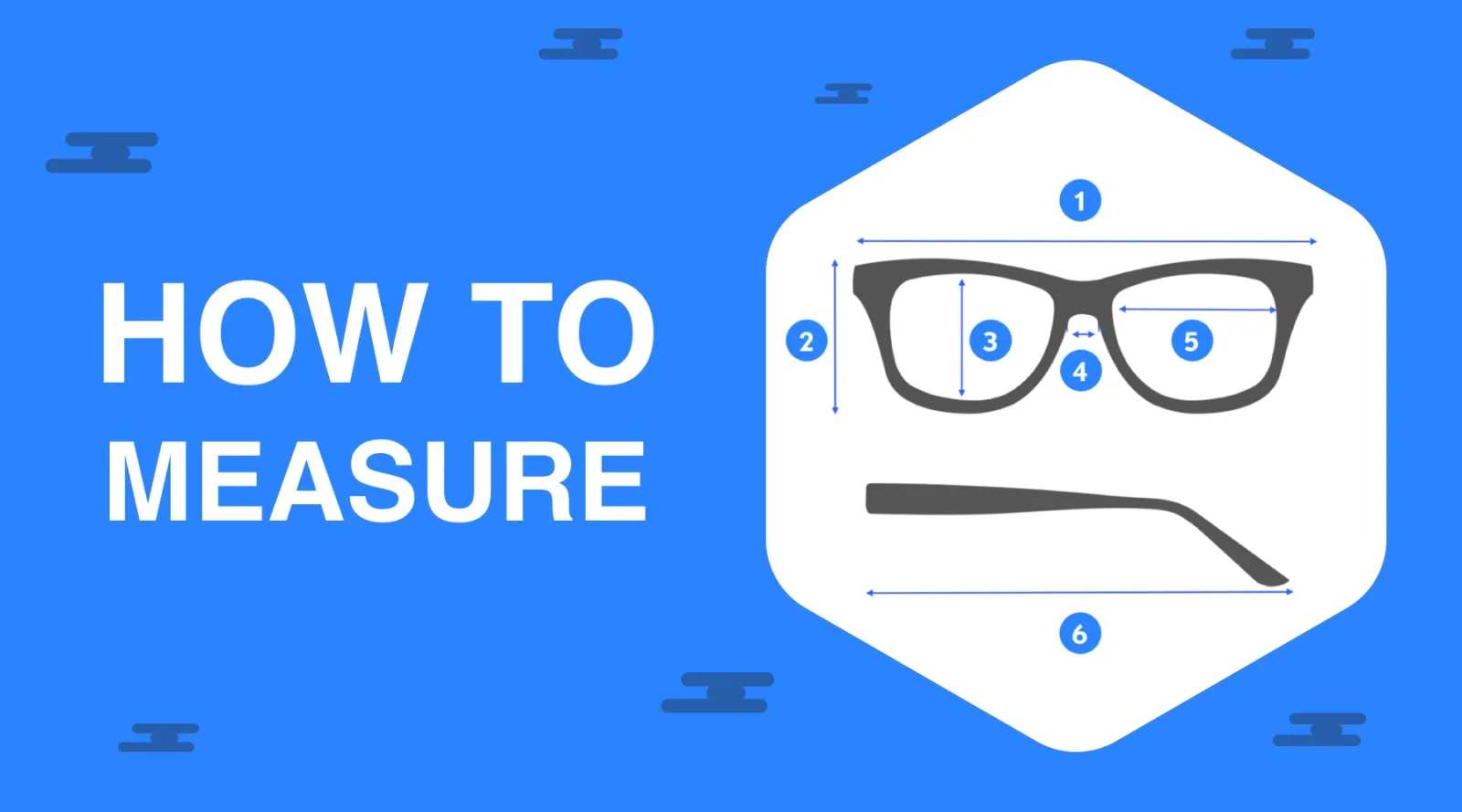
Glasses measure at six points in millimeters: width, height, lens height, lens width, bridge and arm, in that order of fit-impact. Three already sit on most frames as the code 52-18-140: lens width, bridge and arm. Hover or tap each step on the diagram to see where the ruler sits. Sizely turns those numbers into a chart buyers trust.
Eyewear fit is decided in millimeters, not S/M/L, and the number a buyer trusts is the frame's total width across the front. Three of these points already live on the frame as the 52-18-140 style code most listings ignore. This page draws all six on the frame itself, so total width and height, both lens dimensions, the bridge and the arm each get a precise figure.

- A
Width
The total frame width, taken straight across the front from the outer edge of one hinge to the other. Hover or tap this step to see the line. This is the headline fit number, since it sets how wide the frame sits across the face.A single straight run in millimeters. Recorded as-is. Do not double.
- B
Height
The total frame height, measured from the top of the frame to the bottom at the tallest point of the front. Tap the step to see where the line runs. Taller fronts suit larger faces and bigger lenses; shorter fronts read more compact.Recorded as-is. Do not double.
- C
Lens H
The lens height, measured vertically across one lens at its tallest point inside the rim. This drives how much of the field of view the lens covers, which matters most for reading and progressive lenses.Recorded as-is. Do not double.
- D
Lens W
The lens width, the horizontal span of one lens at its widest, and the first number in the frame code. Tap the step to see the line. On a 52-18-140 frame this is the 52.Recorded as-is. Do not double.
- E
Bridge
The gap between the two lenses where the frame rests on the nose, the second number in the code. On a 52-18-140 frame this is the 18. A wider bridge suits a broader nose; too narrow and the frame pinches.Recorded as-is. Do not double.
- F
Arm
The temple arm, measured along its full length from the hinge to the tip that sits behind the ear, the third number in the code. On a 52-18-140 frame this is the 140. It sets how far back the frame reaches and whether it holds without sliding.Recorded as-is. Do not double.
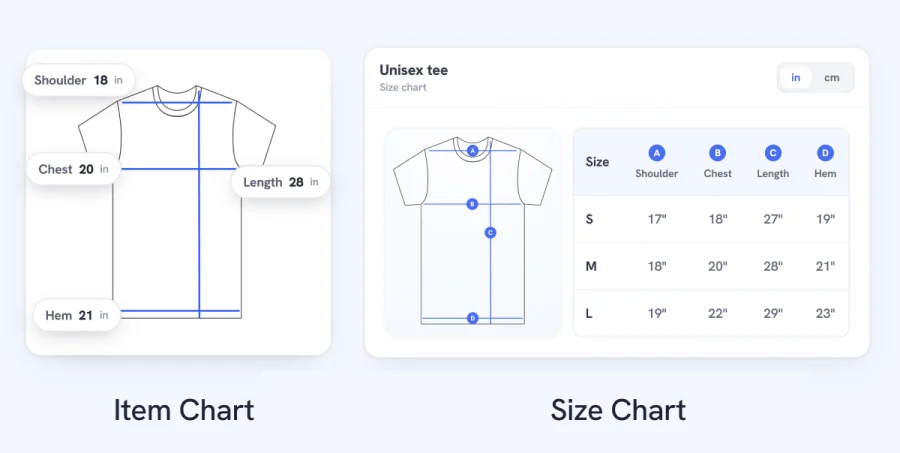
Put exact measurements on every listing, whether you sell on eBay, Shopify, or your own store.
Create your free size chart
Every garment measured in 0.92 seconds, with pro photos, labels, and descriptions, from your iPhone.

Measure flat on a hard surface with a millimeter ruler, never by eye, since a few millimeters change the whole fit. Glasses are small-scale, so every point here is a single straight run recorded exactly as measured. Nothing on a frame doubles. The frame code reads lens width, then bridge, then arm length, for example 52-18-140 means a 52 mm lens, an 18 mm bridge and 140 mm arms.
Glasses size reference
| Size | Width | Height | Lens W | Bridge | Arm |
|---|---|---|---|---|---|
| XS | 125 | 38 | 46 | 16 | 135 |
| S | 130 | 40 | 49 | 17 | 140 |
| M | 138 | 42 | 52 | 18 | 140 |
| L | 145 | 45 | 55 | 19 | 145 |
| XL | 150 | 48 | 58 | 21 | 150 |
Frequently asked
What do the numbers on glasses frames mean?
The set printed inside the arm, like 52-18-140, is lens width, bridge width and arm length, all in millimeters. So 52-18-140 means a 52 mm lens, an 18 mm bridge between the lenses and 140 mm temple arms. These three numbers are the quickest way to compare a new frame against a pair you already know fits.
Do I double any glasses measurement?
No. Every glasses measurement is a single straight run in millimeters, taken once across the frame or lens. There is no folded layer to account for the way there is on a flat shirt or glove, so nothing doubles. Record each point exactly as the ruler reads it, and keep the unit in millimeters to match the industry standard.
How do I know what size glasses fit my face?
The fastest check is to read the 52-18-140 style code off a pair you already wear comfortably and match the total width and those three numbers on the new frame. If you have no reference pair, measure your face width across the temples in millimeters and look for a total frame width close to it. A few millimeters off in either direction is usually fine.
Should I measure glasses in inches or millimeters?
Millimeters, always. Eyewear is sized in millimeters worldwide, and the frame code itself is printed that way, so an inch measurement would not line up with any listing or prescription. A millimeter ruler is the right tool here, since a single millimeter is enough to change how a small frame sits.
Where exactly is the frame width measured on glasses?
Straight across the front of the frame at its widest, from the outer edge of one hinge to the outer edge of the other, with the arms folded flat. This total width is the single best fit indicator, more reliable than lens width alone, because it accounts for the bridge and both rims together. Hover or tap the width step on the diagram to see the exact line.
Related size charts & tools
 How to measure a hat
Sources: Sizely garment engine, spec #113 (Cat Eye glasses), six named measurement points. ISO 8624 ophthalmic frame measurement system (lens, bridge and side length in millimeters). Last verified June 2026.
Make the right size obvious.
Join 85,000+ sellers showing measurements buyers trust. Free to start, no card needed.