How to measure a coat
Every point, drawn on the garment so there is no guessing where the tape goes.
Quick answer
Lay the coat flat and capture ten points in fit order: chest, length, shoulder, sleeve A, sleeve B, cuff, waist, hem, arm and forearm. Chest leads, taken across a fastened front with room for the layers underneath. Hover or tap each step on the diagram for the line. Sizely turns those numbers into a chart buyers trust.
Before buying a coat, people check chest and length, because a coat has to close over heavy layers and fall to the length they want. Generic guides give three or four points and leave sleeve, cuff and hem unanswered. This page draws all ten on the garment itself, so a buyer can match your coat against one already hanging in their closet.

- A
Chest
Fasten the front, smooth the coat flat, and draw the tape straight across one inch below the armhole seams. Tap this step on the diagram to lock the line. A coat is cut to clear a jacket or sweater, so expect a generous reading here.Double it for the full chest circumference.
- B
Length
A single run from the top of the shoulder seam down to the very hem. Tap the step to see the start and end so you follow the back panel through any belt or vent. On a coat, length is what separates a hip-length style from a full overcoat.Recorded as-is. Do not double.
- C
Shoulder
From one shoulder seam straight across the back to the other. This fixes how broad the coat sits and, with a heavier shell, how the weight hangs from the shoulders.Recorded as-is. Do not double.
- D
Sleeve A
The upper sleeve, run from the shoulder seam toward the elbow. Keeping the sleeve in two parts stops a long coat sleeve from collapsing into one vague figure.Recorded as-is. Do not double.
- E
Sleeve B
The lower sleeve, carried from the elbow point out to the cuff. Add the two runs for a full sleeve a buyer can trust will cover the wrist over a jumper.Recorded as-is. Do not double.
- F
Cuff
Across the sleeve opening at the wrist. A coat sleeve has to pass over a thick layer, so the cuff width is a real wearability check, not a detail to skip.Double it for the full cuff circumference.
- G
Waist
Across the narrowest part of the side seam, or at the belt line on a belted coat. The difference between chest and waist tells a buyer whether the coat falls straight or nips in.Double it for the full waist circumference.
- H
Hem
Across the bottom opening, edge to edge. A wide hem gives a full, draping sweep; a narrow one reads slim and tailored at the bottom.Double it for the full hem circumference.
- I
Arm
Across the widest part of the upper sleeve at the bicep. With a coat this is what lets a padded or knit sleeve slide inside without binding.Double it for the full bicep circumference.
- J
Forearm
Across the lower sleeve closer to the cuff. Paired with the cuff number, it shows how much the sleeve narrows from bicep to wrist.Double it for the full forearm circumference.
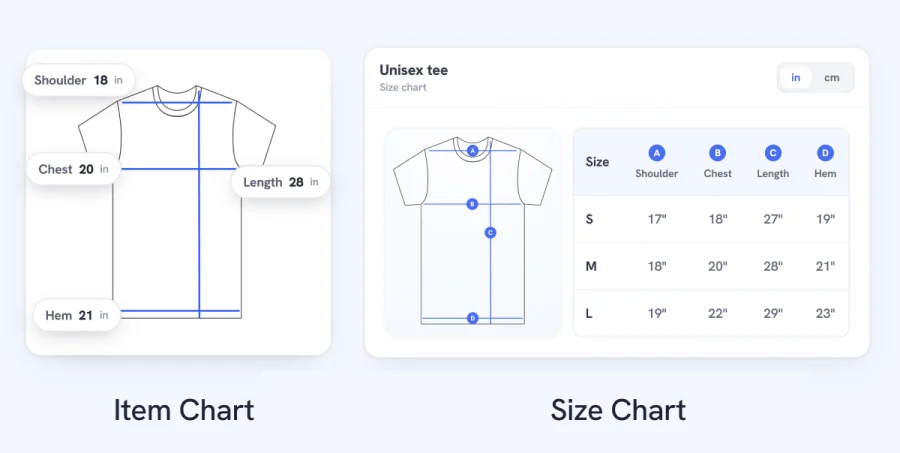
Put exact measurements on every listing, whether you sell on eBay, Shopify, or your own store.
Create your free size chart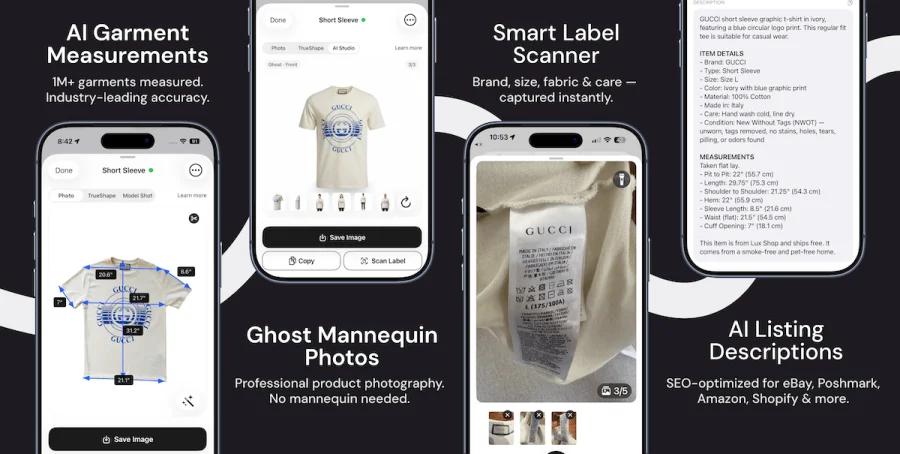
Every garment measured in 0.92 seconds, with pro photos, labels, and descriptions, from your iPhone.

Measure flat and never stretched, with the coat fastened all the way and the heavy cloth pressed smooth so it lies even on the table. A coat carries deliberate room for layers, so resist pulling the fabric tight to make a number look smaller. Chest, waist, hem and cuff cross one layer and double to a circumference; length, shoulder, both sleeve runs, arm and forearm are single passes recorded as they read.
Coat size reference
| Size | Chest | Length | Shoulder | Sleeve | Waist |
|---|---|---|---|---|---|
| S | 21 | 40 | 18 | 25 | 20 |
| M | 23 | 41 | 18.5 | 25.5 | 22 |
| L | 25 | 42 | 19 | 26 | 24 |
| XL | 27 | 43 | 19.5 | 26.5 | 26 |
| 2XL | 29 | 44 | 20 | 27 | 28 |
Frequently asked
How much extra room should a coat have over a jacket?
A coat is drafted with built-in ease so it closes over a jacket or thick sweater, so its flat chest typically runs a few inches wider than a same-size jacket. You do not add that room yourself; it is already in the cut. Measure the coat flat and list the real numbers, then a buyer layering underneath can see exactly how much space is there.
How do I measure coat length the right way?
Run a single vertical pass from the highest point of the shoulder seam straight down to the bottom hem, keeping the tape against the back panel rather than following a belt or flare. Record it exactly as measured, since length is a linear run and never doubled. This is the number that tells a buyer whether the coat hits the hip, the thigh or the knee.
Which coat measurements do I double and which stay as measured?
Double the across points, chest, waist, hem and cuff, because each is read over a single flat layer and the body figure is about twice the flat. Length, shoulder, both sleeve runs, arm and forearm are single passes, so the flat number is the real number. For women's coats checked against numbered sizing, our women's international size chart lines the figures up.
Should coat measurements be in inches or centimeters?
Both work as long as you pick one, label it, and keep every row consistent. Coat buyers often shop across borders for the warmest option, so listing inches and centimeters together removes a barrier. Sizely shows both units on each chart, so no buyer has to convert before deciding.
Why does my coat feel heavy on the shoulders even in my usual size?
A coat hangs its full weight from the shoulder seam, so if the shoulder measurement runs wider than your frame the cloth pulls down and feels heavy. Match the flat shoulder number to your own shoulder width first, then check chest for layering room. The garment measurements tell that story far better than the size on the label.
Related size charts & tools
 Men's international size chart
 Women's international size chart
Sources: Sizely garment engine, spec #122 (Long Coat), ten named measurement points. ISO 8559-1 garment body-measurement definitions (representative ranges only). Last verified June 2026.
Make the right size obvious.
Join 85,000+ sellers showing measurements buyers trust. Free to start, no card needed.