How to measure a cap
Every point, drawn on the garment so there is no guessing where the tape goes.
Quick answer
A cap measures at three points: circumference, arc and beak, in that order of fit-impact. Circumference is the sizing number, read around the inside of the sweatband, the inner opening generic listings skip. Hover or tap each step on the diagram to see exactly where the tape sits. Sizely turns those numbers into a size chart buyers trust.
The question a buyer has about a cap is simple: will it go on my head and stay. That comes down to the circumference, the inside band opening, which is what cap sizing is built on. Most listings give a flat S/M/L or just say adjustable. This page measures all three points on the cap itself, so the head opening, the crown arc and the beak each get a number.

- A
Circumference
The fit number, so it comes first. Trace the tape around the inside of the sweatband where the cap meets the head, all the way around the inner opening. Hover or tap this step to see the loop. On a fitted cap this is the size; on a snapback it is the smallest setting the band closes to.Read around the inner opening, so it already equals the full head circumference. Do not double.
- B
Arc
The crown seam, measured along the curve from the front edge of the band, up and over the top, to the back. Tap the step to follow the arc line. A longer arc means a taller, deeper crown that sits high; a shorter arc hugs flatter.Recorded as-is. Do not double.
- C
Beak
The visor, measured straight out from the front of the band to the tip of the brim. This sets how far the bill reaches and how much shade it casts over the eyes.Recorded as-is. Do not double.
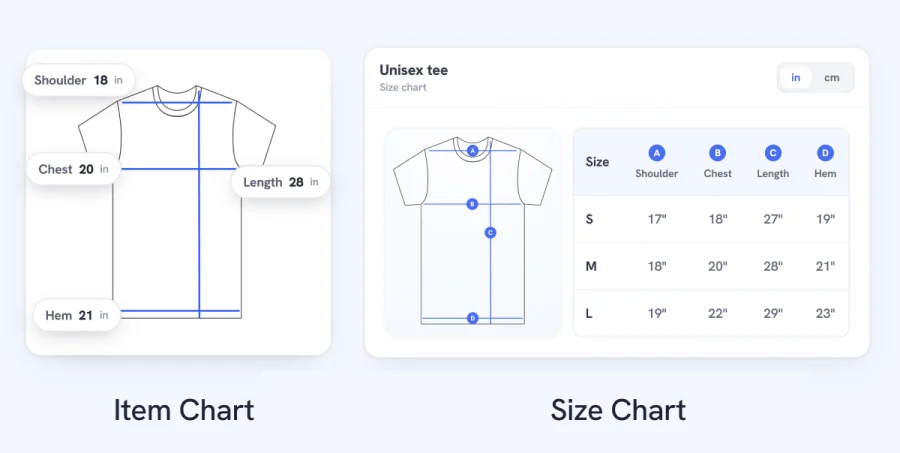
Put exact measurements on every listing, whether you sell on eBay, Shopify, or your own store.
Create your free size chart
Every garment measured in 0.92 seconds, with pro photos, labels, and descriptions, from your iPhone.

Measure flat and unstretched, with the cap shaped as it would sit on a head. Lay the sweatband in an even circle and read it without tension, since a fitted cap has give and a snapback adjusts. The circumference loops the inner opening, so it reads the head size directly with no doubling. Arc and beak are single straight passes, recorded as-is. No cap measurement gets doubled.
Cap size reference
| Size | Circumference | Arc | Beak |
|---|---|---|---|
| S/M | 21.75 | 11.5 | 2.75 |
| M/L | 22.75 | 11.75 | 2.75 |
| L/XL | 23.75 | 12 | 3 |
| XL | 24.5 | 12.25 | 3 |
| 2XL | 25.5 | 12.5 | 3.25 |
Frequently asked
How do I measure my head for a baseball cap?
Run a soft tape around the widest part of your head, sitting about a finger-width above the ears and brow where a cap band rests. Keep it level and snug without digging in. That circumference is your head size, and it should line up with the cap's inner band number. For the full US fitted run and international equivalents, see our hat size chart.
Do I double the cap circumference measurement?
No. The cap's circumference is taken around the whole inner opening, so it already reads as the full head size. Doubling only applies to flat across measurements like a chest or waist, where the tape spans one folded layer. A cap band is a complete loop, so the number you read is the number that goes on a head.
What is the difference between a fitted cap and an adjustable cap size?
A fitted cap is built to one exact circumference and has no closure, so the band number must match the head closely. An adjustable cap, like a snapback or strapback, covers a range and the listed circumference is the closed or smallest setting. List the real band measurement either way, since adjustable does not mean it fits everyone.
What cap size am I from my head measurement?
Match your head circumference to the band number. Roughly, about 22 inches lands around S/M, 23 inches around L/XL, and 24 inches and up toward XL, though shape and brand shift this. For exact fitted sizing and US, UK and EU conversions, our hat size chart is more reliable than a generic letter size.
Should I measure a cap in inches or centimeters?
Both are fine as long as you label the unit and keep it consistent across the listing. Caps sell across borders constantly, so showing inches and centimeters together saves buyers the conversion. Sizely lists both on every chart so the head size reads clearly in either system.
Related size charts & tools
 Hat size chart
 How to measure a hat
Sources: Sizely garment engine, spec #14 (Cap), three named measurement points. EN 13402 body-dimension sizing reference (head girth, representative ranges only). Last verified June 2026.
Make the right size obvious.
Join 85,000+ sellers showing measurements buyers trust. Free to start, no card needed.