
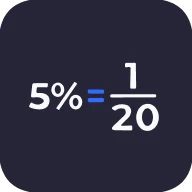
Percent to Fraction Calculator
Free percent to fraction calculator. Convert any percentage, including decimals and values over 100, to a fraction in lowest terms with the steps shown.
There was an error with your calculation.
Answer
5
8
Percent to fraction at a glance#
A percent to fraction calculator writes a percentage as a fraction. The rule is to put the percent over 100, then simplify by dividing the top and bottom by their greatest common divisor. So 25% is 25/100, which simplifies to 1/4, and 50% simplifies to 1/2.
| Percent | Fraction |
|---|---|
| 10% | 1/10 |
| 20% | 1/5 |
| 25% | 1/4 |
| 40% | 2/5 |
| 50% | 1/2 |
| 75% | 3/4 |
| 80% | 4/5 |
To convert by hand, write the percent over 100 and reduce: 75% is 75/100, and dividing both by 25 gives 3/4. A percent above 100 gives a fraction greater than 1, so 150% is 150/100, or 3/2, which is the mixed number 1 1/2.
Enter your percentage in the calculator above for the exact fraction in lowest terms. A percent with decimals, like 12.5%, first becomes 125/1000 and then simplifies to 1/8.
Converting a decimal percentage#
When the percent has digits after the decimal point, scale away the decimal before you reduce. Count the decimal places, put the number over 100, then multiply the top and bottom by 10 for each decimal place so the numerator becomes a whole number.
For 30.5%, start with 30.5/100. There is one decimal place, so multiply both parts by 10 to get 305/1000. Divide both by their greatest common divisor, 5, and the fraction reduces to 61/200. The result is exact, not rounded.
Percentages over 100#
A percent above 100 represents more than one whole, so it gives an improper fraction that you can also write as a mixed number. Put the percent over 100 and reduce as usual, then convert to a mixed number if you want the whole part shown.
For 125%, write 125/100 and divide both parts by 25 to get 5/4. As a mixed number that is 1 1/4. For 150%, 150/100 reduces to 3/2, which is 1 1/2.
Negative percentages#
A negative percent keeps the sign through the conversion. Convert the size as if it were positive, then attach the minus sign to the result. So -85% is -85/100, and dividing both parts by 5 gives -17/20.
Why reduce to lowest terms#
Every percent starts as a fraction over 100, but 100 shares factors with most numerators, so the first fraction is rarely in its simplest form. Dividing the numerator and denominator by their greatest common divisor gives the cleanest equivalent fraction. 40/100 and 2/5 are equal, but 2/5 is the standard way to write it and the easier form to use in further calculations.
Frequently asked questions#
How do you convert a percent to a fraction?#
Put the percent over 100 and reduce by dividing the top and bottom by their greatest common divisor. So 60% is 60/100, and dividing both by 20 gives 3/5.
How do you convert a decimal percent like 12.5% to a fraction?#
Scale away the decimal first. 12.5% is 12.5/100, and multiplying both parts by 10 gives 125/1000, which reduces to 1/8. Each decimal place means one more factor of 10 on the top and bottom.
What is a percent over 100 as a fraction?#
It becomes a fraction greater than 1, which you can write as a mixed number. 125% is 125/100, or 5/4, which is the mixed number 1 1/4.
Can a negative percent become a fraction?#
Yes. Convert the value as usual and keep the minus sign on the result. -85% is -85/100, which reduces to -17/20.
Why does the calculator reduce the fraction?#
Because the raw fraction over 100 usually shares factors with 100, so it is not in standard form. Dividing both parts by their greatest common divisor gives the simplest equal fraction, like turning 40/100 into 2/5.
Related calculators
View all calculators Ratio CalculatorFree ratio calculator that simplifies a ratio to lowest terms and solves a proportion for a missing value. See the steps, formula, and worked examples.
 Right Triangle CalculatorFree right triangle calculator: solve sides, angles, area and perimeter from any two values using the Pythagorean theorem and trig ratios.
 Rounding CalulatorFree rounding calculator. Round any number to the nearest 10, 100, whole number, decimal place, or cent using the round-half-up rule, with examples.
 Scientific Notation CalculatorFree scientific notation calculator: convert numbers to and from a x 10^n, plus e-notation and engineering notation, with worked steps.
 Sig Fig CalculatorFree sig fig calculator: count the significant figures in any number and round to a chosen count, with the four sig fig rules and examples.
 Significant Figures CalculatorFree significant figures calculator: round to a set number of sig figs and apply the add, subtract, multiply and divide precision rules.