
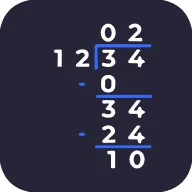
Long Division Calculator
Free long division calculator: divide numbers step by step and get the quotient, remainder and mixed-number form, with every step shown.
There was an error with your calculation.
Answer
17÷3 = 5 R 2 = 5 2/3
Long division at a glance#
A long division calculator divides one whole number by another and returns the quotient and the remainder, the amount left over that will not divide evenly. It works through the standard four-step method: divide, multiply, subtract, then bring down the next digit.
For example, 125 ÷ 4 = 31 remainder 1. To check it, multiply the quotient by the divisor and add the remainder: 4 × 31 + 1 = 125. The remainder is always smaller than the divisor.
| Step | What You Do | Using 125 ÷ 4 |
|---|---|---|
| Divide | How many times the divisor fits | 4 goes into 12 three times |
| Multiply | Multiply that digit by the divisor | 3 × 4 = 12 |
| Subtract | Subtract to find what is left | 12–12 = 0 |
| Bring down | Bring down the next digit and repeat | Bring down 5: 4 goes into 5 once, leaving 1 |
Repeating those steps gives a quotient of 31 with 1 left over, which you can also write as the mixed number 31 1/4. Another worked result: 168 ÷ 15 = 11 remainder 3.
Enter your dividend and divisor in the calculator above to see every step, plus the quotient, remainder and mixed-number form. Continue past the remainder with decimals if you need an exact decimal answer instead.
How long division works#
Long division breaks a division into a repeating four-step cycle: divide, multiply, subtract, then bring down the next digit. You enter a dividend (the number being divided) and a divisor (the number you divide by), and the result is a quotient plus a remainder, the part that will not divide evenly. The remainder is always smaller than the divisor.
A worked example#
Take 168 ÷ 15. The divisor 15 goes into 16 once (1 × 15 = 15), leaving 1; bring down the 8 to make 18; 15 goes into 18 once more (1 × 15 = 15), leaving 3. The quotient is 11 with a remainder of 3, written as the mixed number 11 3/15, which simplifies to 11 1/5. To check any result, multiply the quotient by the divisor and add the remainder: 15 × 11 + 3 = 168.
Everyday uses#
Long division answers "how many fit, with how much left over." If you have 150 dollars and each toy train costs 11, then 150 ÷ 11 = 13 with 7 left, so you can buy 13 trains and keep 7 dollars. If you fill treat bags with 8 bears each from 130 bears, 130 ÷ 8 = 16 with 2 left, so you fill 16 bags and have 2 bears spare. The widget above shows every step for cases like these.
Long division calculator FAQ#
What is a long division calculator?#
It divides one number by another and shows the full worked process, giving the quotient, the remainder and every divide, multiply, subtract and bring-down step. For example, 168 ÷ 15 = 11 remainder 3.
How does the long division method work?#
It repeats four steps until no digits remain: divide the divisor into the current digits, multiply the result back, subtract to find what is left, then bring down the next digit. The cycle ends with a quotient and a remainder smaller than the divisor.
What is the difference between a remainder and a decimal answer?#
A remainder is the whole-number amount left over, as in 168 ÷ 15 = 11 r3. If you keep dividing past the decimal point instead of stopping, you get a decimal answer, here about 11.2.
Can it handle answers with a repeating decimal?#
Yes. When the division never ends evenly, the digits start to repeat, and the calculator continues past the decimal point and marks the repeating sequence.
Does it work with decimals and large numbers?#
Yes. It divides multi-digit numbers and decimals and shows each step, which is useful for checking work or learning the method.
Related calculators
View all calculators Probability CalculatorFree probability calculator: find the chance of an event as a fraction, decimal, or percent, with rules for independent, dependent, and combined events.
 Proportion CalculatorFree proportion calculator: solve a/b = c/d for the missing value by cross-multiplying, with worked examples for recipes, scaling, and map scales.
 Pythagorean Theorem CalculatorFree Pythagorean theorem calculator: solve a squared plus b squared equals c squared to find the hypotenuse or a missing leg, with worked examples.
 Quadratic Formula CalculatorFree quadratic formula calculator. Enter a, b and c to solve ax^2 + bx + c = 0, with the discriminant, real or complex roots, and worked examples.
 Ratio CalculatorFree ratio calculator that simplifies a ratio to lowest terms and solves a proportion for a missing value. See the steps, formula, and worked examples.
 Right Triangle CalculatorFree right triangle calculator: solve sides, angles, area and perimeter from any two values using the Pythagorean theorem and trig ratios.